Why this works
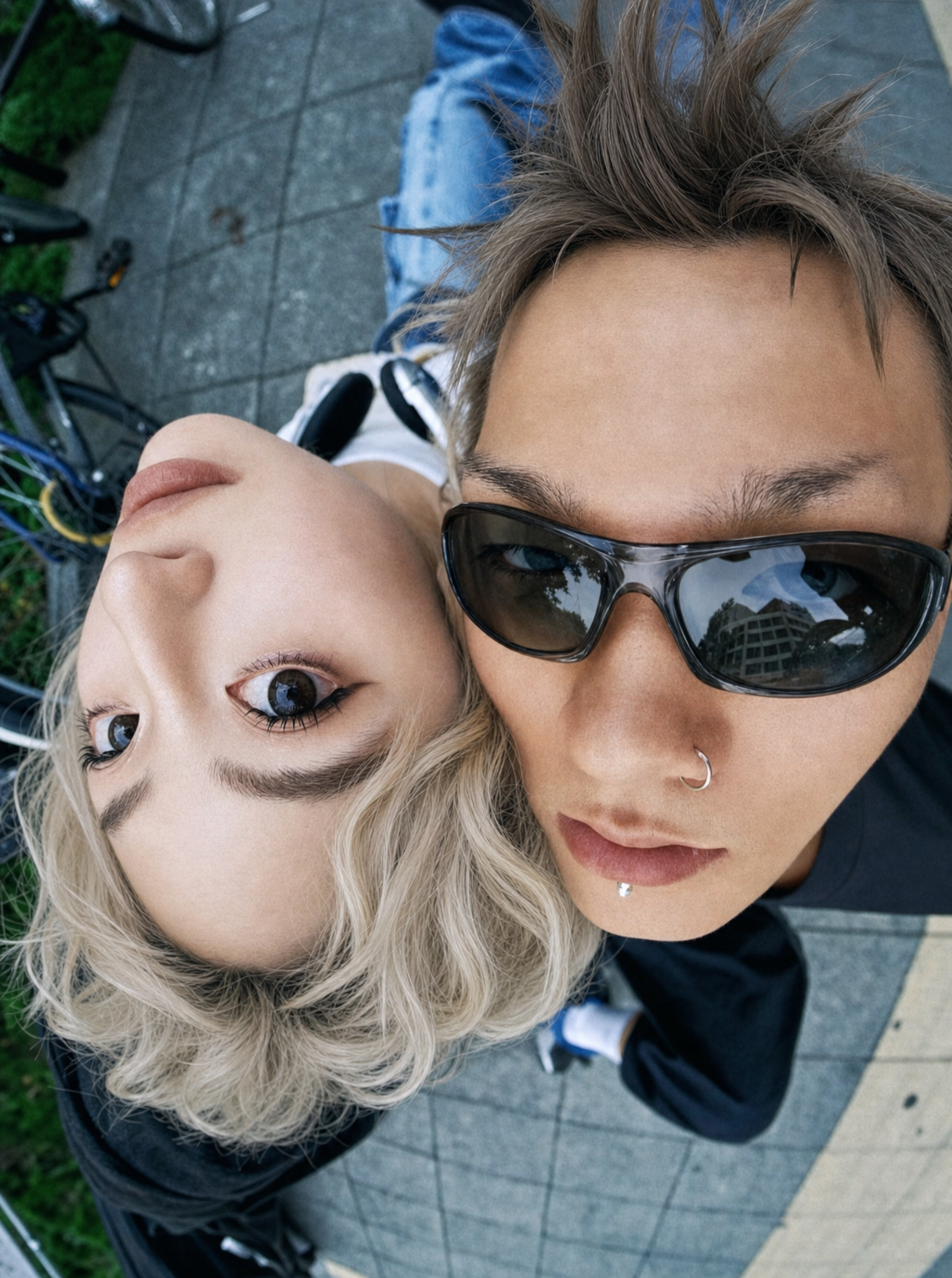
The phrase “wide-angle overhead close-up portrait” makes the sidewalk and both faces share the frame while the unusual viewpoint supplies the “slightly surreal” feeling. “Leaning together” and “intimate composition” create physical closeness, while “black sunglasses,” “matte nude lipstick,” and the urban styling establish a controlled black, beige, and blue palette against the city setting. “Natural midday daylight” and “realistic skin texture” keep the candid fashion image crisp and photographic rather than dreamlike or heavily stylized.
FAQ
→How do I make one person more visually dominant?
Replace “two people” and “leaning together” with “one person in the foreground, the second person partially visible behind them,” then add “foreground face occupying two-thirds of the frame.” Keep “wide-angle overhead close-up portrait” for the viewpoint, or change it to “overhead medium close-up” if you want more body and clothing visible.
→How do I shift the image from crisp and candid to darker and more dramatic?
Replace “Natural midday daylight, crisp and realistic” with “hard late-afternoon side light with deep shadows,” and change “candid fashion photography” to “moody editorial street photography.” Retain “black sunglasses” and “edgy” to preserve the dark styling, while replacing “realistic skin texture” with “high-contrast textured skin detail” for a less polished finish.
→How do I build a series with the same subjects in different urban locations?
Keep the identifying phrases “short ash-brown spiky hair,” “black sunglasses,” “small septum ring,” “shoulder-length platinum hair,” and “matte nude lipstick” unchanged. Swap “city sidewalk in an urban street setting” for specific locations such as “rainy neon-lit alley,” “concrete rooftop beside a parking garage,” or “blue-hour subway entrance,” and adjust “Natural midday daylight” to “colored neon reflections,” “overcast daylight,” or “cool blue-hour light” to match each setting.
Learn the technique behind this
- Why can't AI spell, and how do I get readable text in an image? — Older diffusion models had no character-level representation of text, so they produced letterform-shaped texture instead of words.
- Which aspect ratio should I use, and how does it change the image? — Aspect ratio determines what the model composes, not how it's cropped afterwards.
- How should a prompt be structured, and does word order matter? — A prompt that behaves predictably names one subject first, then what it is doing, then where, then the light, then the lens or medium, then the style.