Why this works
The mysterious, magical mood comes from the specific contrast between “cool blue and teal light streaks” and “faint golden sparks drifting above the pages,” while “dramatic moody lighting” reinforces the tension. “Cinematic close-up” and “rule-of-thirds” keep the open book as the readable anchor, with “shallow depth of field” isolating it against “soft neutral bokeh in the background.” The blue, gray, brown, and white palette balances the cool glow against the “weathered wooden table” and pale pages, while “high detail realistic textures” and “subtle film grain” make the supernatural accents feel photographic rather than illustrated.
FAQ
→How do I make the book feel more mysterious and ominous?
Replace “faint golden sparks drifting above the pages” with “thin black smoke curling from the page gutters” and change “soft neutral bokeh” to “deep charcoal shadows with indistinct shapes.” Keep “cool blue and teal light streaks,” but add “hard directional side-lighting” to create sharper, more threatening contrast.
→How do I make the glowing pages more central and prominent?
Replace “cinematic close-up” with “extreme close-up focused on the illuminated page spread,” and change “shallow depth of field” to “sharp focus across the book’s text and glowing page edges.” Replace “soft neutral bokeh in the background” with “a nearly black blurred background” so the page illumination becomes the strongest visual anchor.
→How do I build a variation with a different subject while keeping this visual style?
Replace “an open book on a rustic wooden table” with “an antique brass compass resting on a weathered wooden table,” and change “faint golden sparks drifting above the pages” to “faint golden sparks orbiting the compass needle.” Retain “cool blue and teal light streaks,” “dramatic moody lighting,” “cinematic photorealism,” and “subtle film grain” to preserve the same magical photographic treatment.
Learn the technique behind this
- Why can't AI spell, and how do I get readable text in an image? — Older diffusion models had no character-level representation of text, so they produced letterform-shaped texture instead of words.
- How should a prompt be structured, and does word order matter? — A prompt that behaves predictably names one subject first, then what it is doing, then where, then the light, then the lens or medium, then the style.
- Do negative prompts work, and what should go in one? — Negative prompts work on models that support a separate negative conditioning channel — mainly Stable Diffusion and FLUX-family models.
Related prompts
Playful brunette beauty ad portrait
Red Lip Balm with Lychee Freshness
Premium wellness pouch with golden spices
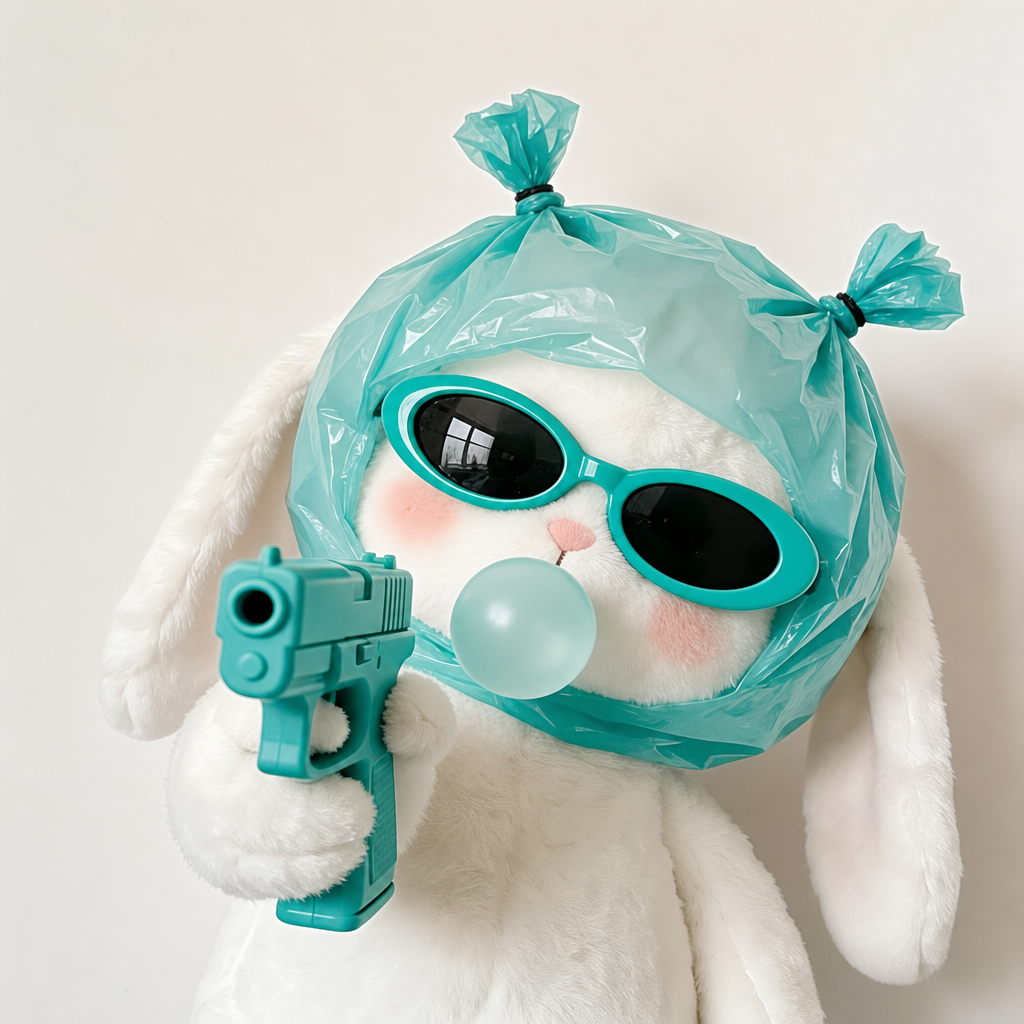
Teal-Accented Bunny Toy Studio Portrait