Why this works
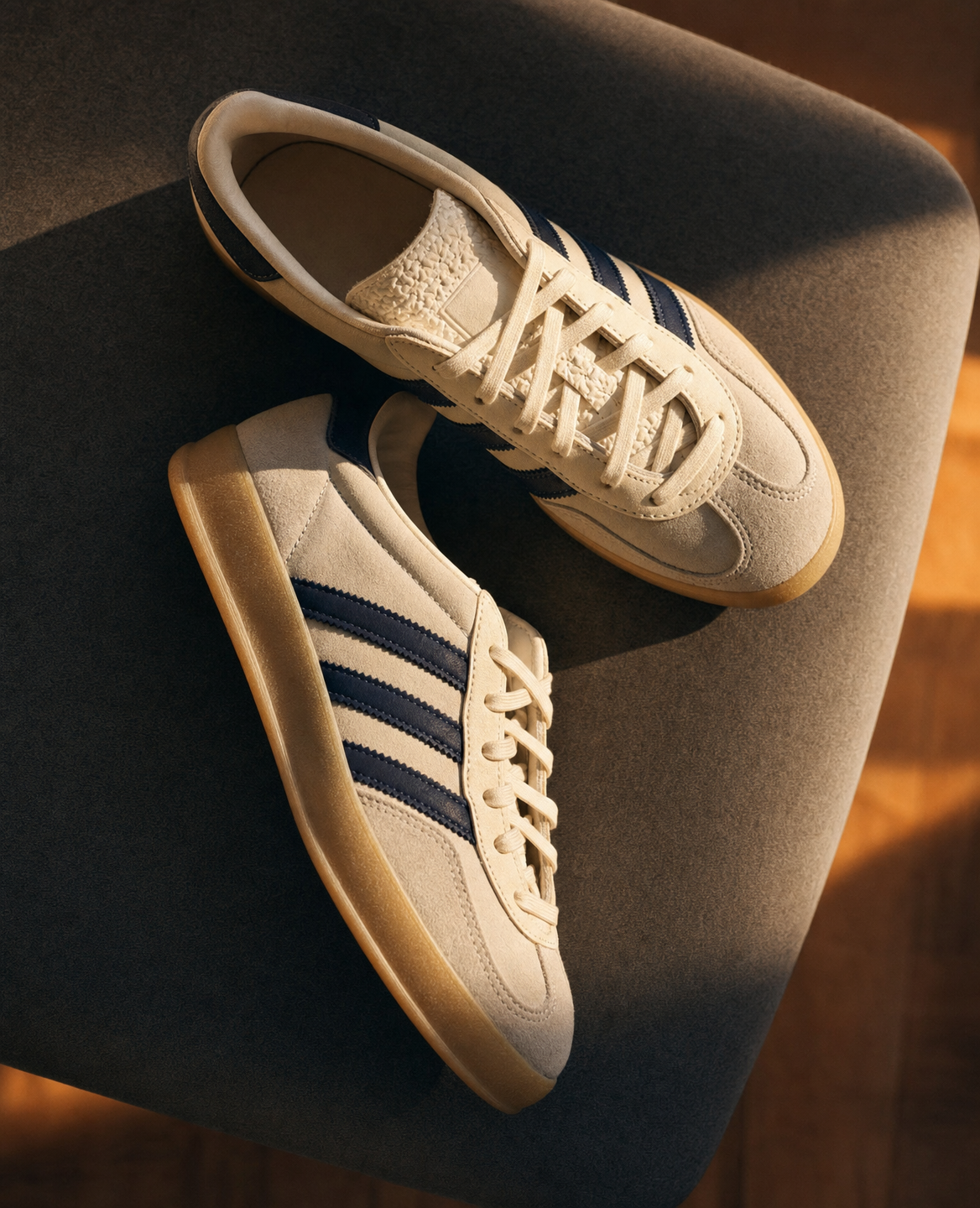
“Top-down photorealistic product photo” gives the pair a clear, centered catalog-style read, while “resting on a soft charcoal-gray upholstered chair” adds the dark, tactile backdrop visible around the shoes. The “off-white uppers and navy side stripes” create the main contrast, and “warm late-afternoon sunlight” supplies the tan and brown warmth through “rich, soft shadows and gentle highlights.” “Highly detailed materials,” specifically “realistic stitching” and “gum-like soles,” keeps the image grounded as a premium lifestyle product shot rather than a flat sneaker illustration.
FAQ
→How do I make one sneaker more prominent than the other?
Replace “two retro sneakers” with “one foreground sneaker and one slightly smaller sneaker behind it,” and change “centered” to “asymmetrical composition with the foreground shoe occupying the lower center.” Keep “top-down” for the overhead view, or replace it with “three-quarter top-down product photo” to reveal more of the featured shoe’s sidewall.
→How do I make the image moodier and less warm?
Replace “warm late-afternoon directional sunlight” with “cool overcast window light,” and change “rich, soft shadows and gentle highlights” to “deeper neutral shadows with restrained highlights.” For a darker backdrop, replace “soft charcoal-gray upholstered chair” with “matte black textured upholstery,” while retaining “off-white uppers and navy side stripes” for controlled contrast.
→How do I turn this into a coordinated series of sneaker variations?
Keep the fixed structure “top-down photorealistic product photo,” “soft charcoal-gray upholstered chair,” and “clean premium lifestyle studio composition,” then swap only “off-white uppers and navy side stripes” for pairs such as “cream uppers with forest-green stripes” or “light-gray uppers with burgundy stripes.” Change “warm late-afternoon sunlight” only when you want a separate lighting chapter, such as “cool morning daylight with crisp, short shadows,” so the framing and material treatment remain consistent.
Learn the technique behind this
- Why can't AI spell, and how do I get readable text in an image? — Older diffusion models had no character-level representation of text, so they produced letterform-shaped texture instead of words.
- How should a prompt be structured, and does word order matter? — A prompt that behaves predictably names one subject first, then what it is doing, then where, then the light, then the lens or medium, then the style.
- Do negative prompts work, and what should go in one? — Negative prompts work on models that support a separate negative conditioning channel — mainly Stable Diffusion and FLUX-family models.
Related prompts
Playful brunette beauty ad portrait
Red Lip Balm with Lychee Freshness
Premium wellness pouch with golden spices
Teal-Accented Bunny Toy Studio Portrait