Same prompt, generated with each model separately — click one to see how it holds up.
Why this works
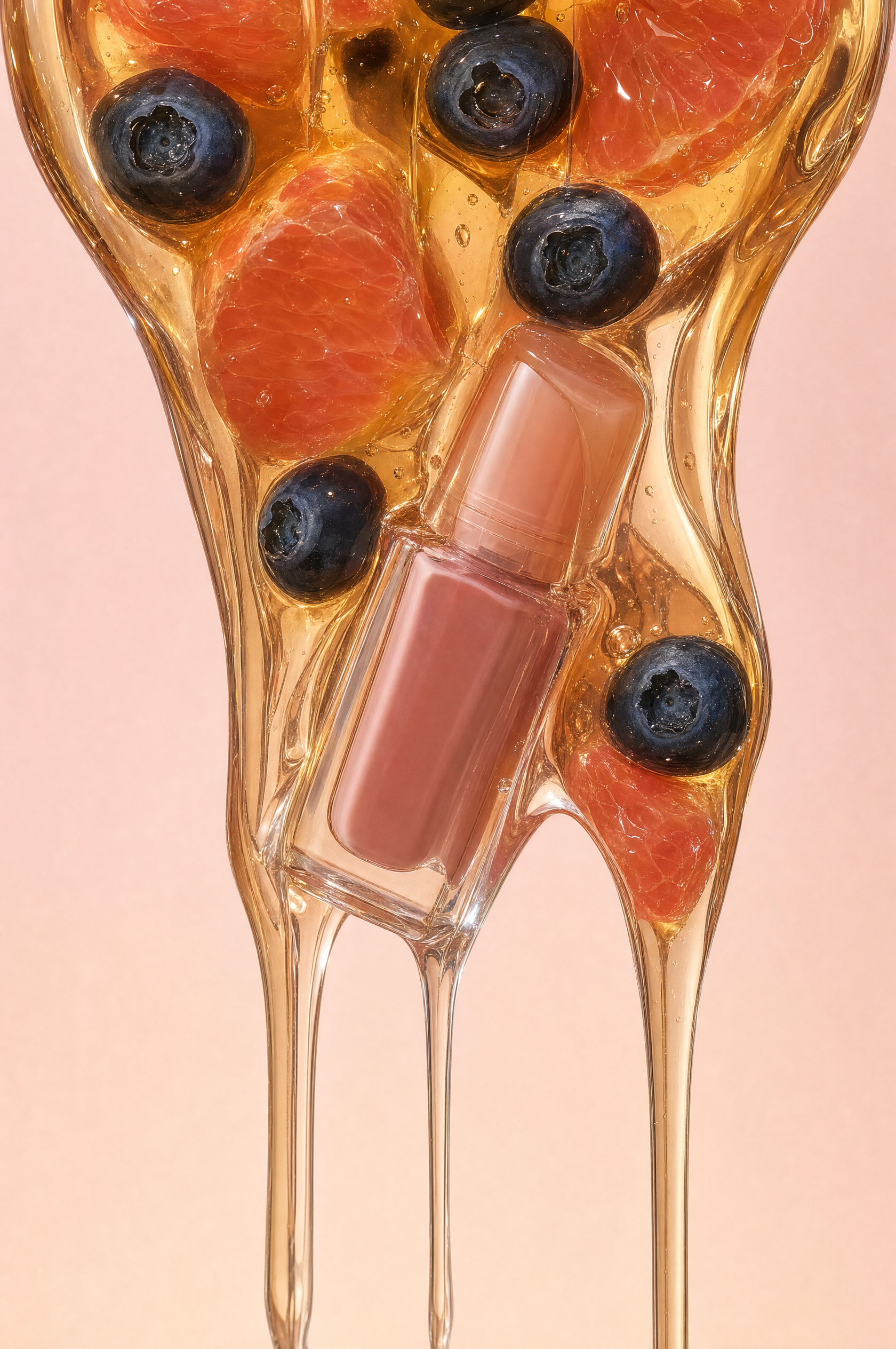
The phrase “nude pink lip gloss bottle suspended inside translucent amber-gold jelly” supplies the central macro subject and the glassy refraction that makes the still life feel indulgent. “Small blueberries and grapefruit segments scattered around it” adds playful fruit contrast, while “soft warm blush background” and “creamy nude lip-gloss tones” connect the pink and orange palette; the blueberries introduce the image’s black-blue visual anchors. “Close-up vertical composition,” “crisp highlights,” and “gentle bokeh” keep attention on the bottle while preserving a polished K-beauty campaign finish.
FAQ
→How do I make the lip gloss bottle more prominent than the fruit and jelly?
Replace “small blueberries and grapefruit segments scattered around it” with “a few tiny blueberries and two restrained grapefruit wedges placed at the distant edges,” and add “lip gloss bottle centered, occupying most of the vertical frame, unobstructed label and cap.” Keep “close-up vertical composition” to preserve the macro emphasis.
→How do I change the fresh, juicy mood into a darker luxury campaign?
Replace “soft warm blush background” with “deep burgundy-to-plum background,” change “high-key lighting” to “controlled low-key spotlighting,” and replace “fresh ‘juicy’ K-beauty campaign look” with “moody premium beauty campaign look.” Retain “realistic reflections and refractions” so the bottle and jelly remain sharply luxurious rather than muddy.
→How do I build a coordinated series with different fruit and gloss shades?
Keep the fixed structure “a [shade] lip gloss bottle suspended inside translucent [color] jelly” and replace “blueberries and grapefruit segments” with one fruit pairing per image, such as “raspberries and lime slices” or “cherries and blood-orange segments.” Swap “creamy nude lip-gloss tones” for the matching shade, such as “cool raspberry-pink gloss tones,” while retaining “soft warm blush background” and “close-up vertical composition” for consistency.
Learn the technique behind this
- Why can't AI spell, and how do I get readable text in an image? — Older diffusion models had no character-level representation of text, so they produced letterform-shaped texture instead of words.
- Which aspect ratio should I use, and how does it change the image? — Aspect ratio determines what the model composes, not how it's cropped afterwards.
- How should a prompt be structured, and does word order matter? — A prompt that behaves predictably names one subject first, then what it is doing, then where, then the light, then the lens or medium, then the style.
Related prompts
Playful brunette beauty ad portrait
Red Lip Balm with Lychee Freshness
Premium wellness pouch with golden spices
Teal-Accented Bunny Toy Studio Portrait