Why this works
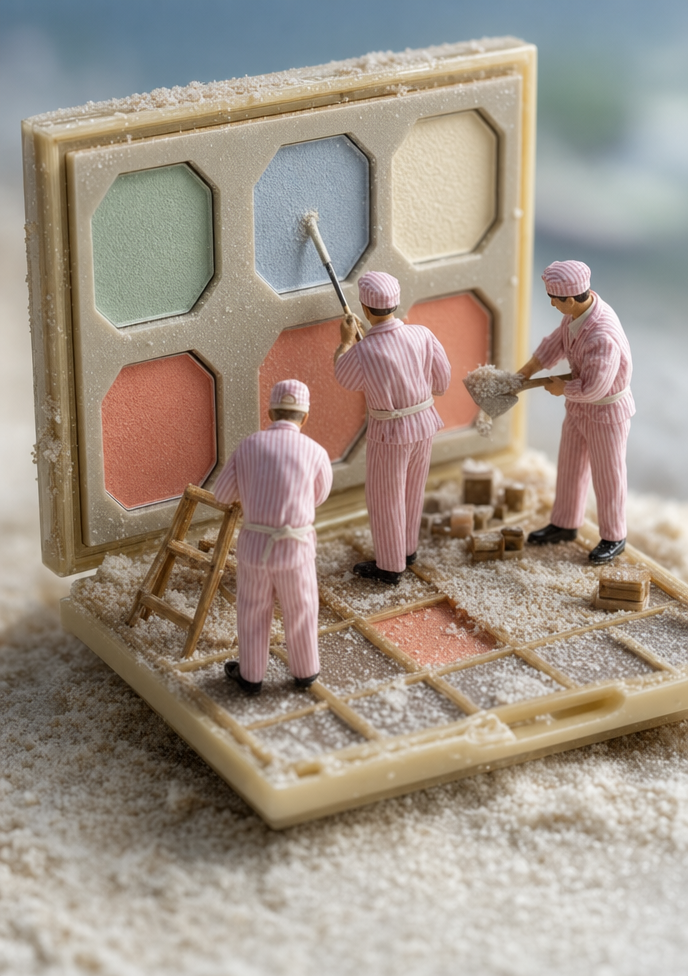
The centered composition comes from the “cinematic composition” and the single palette-focused setup, keeping the workers and pastel compartments readable as one product tableau. A whimsical, delicate mood is pinned by “three tiny miniature workers,” “small scaffold,” and “powder snow-like across the surface,” while “soft overcast natural lighting” and “shallow depth of field” soften the pink, white, and gray palette and separate the active painting area from the background. “Photorealistic macro” and “highly detailed realistic textures” make the powder, brushwork, and miniature surfaces carry convincing scale.
FAQ
→How do I make one miniature worker the clear focal point?
Replace “three miniature workers painting and texturing” with “one miniature worker in sharp focus, standing on a small scaffold and painting the central octagonal pan,” and add “the other two workers blurred in the background.” Keep “shallow depth of field,” but change “cinematic composition” to “tight off-center composition with the scaffolded worker centered.”
→How do I change the dreamy pastel mood into a more dramatic workshop scene?
Replace “soft overcast natural lighting” with “dramatic directional spotlight with deep shadows,” and replace “mint green, powder blue, vanilla cream, and light coral” with “charcoal, burgundy, copper, and deep plum.” Change “powder snow-like across the surface for a whimsical, dreamy feel” to “dense pigment dust, visible tool marks, and a tense late-night workshop atmosphere.”
→How do I build a series of variations without losing the miniature product-diorama look?
Keep “photorealistic macro diorama,” “three tiny miniature workers,” “highly detailed realistic textures,” and “shallow depth of field” unchanged, then swap the task and product: use “assembling a miniature perfume bottle,” “repairing a tiny mechanical watch,” or “decorating a ceramic teacup.” Replace the palette colors with a controlled four-color scheme for each variation, such as “amber, ivory, rose, and smoke gray,” while retaining “whimsical product-style set” for visual continuity.
Learn the technique behind this
- Why can't AI spell, and how do I get readable text in an image? — Older diffusion models had no character-level representation of text, so they produced letterform-shaped texture instead of words.
- How do I keep one consistent style across a whole set of images? — Style consistency is more achievable than character consistency because style lives in describable attributes.
- How should a prompt be structured, and does word order matter? — A prompt that behaves predictably names one subject first, then what it is doing, then where, then the light, then the lens or medium, then the style.
Related prompts
Playful brunette beauty ad portrait
Red Lip Balm with Lychee Freshness
Premium wellness pouch with golden spices
Teal-Accented Bunny Toy Studio Portrait