Why this works
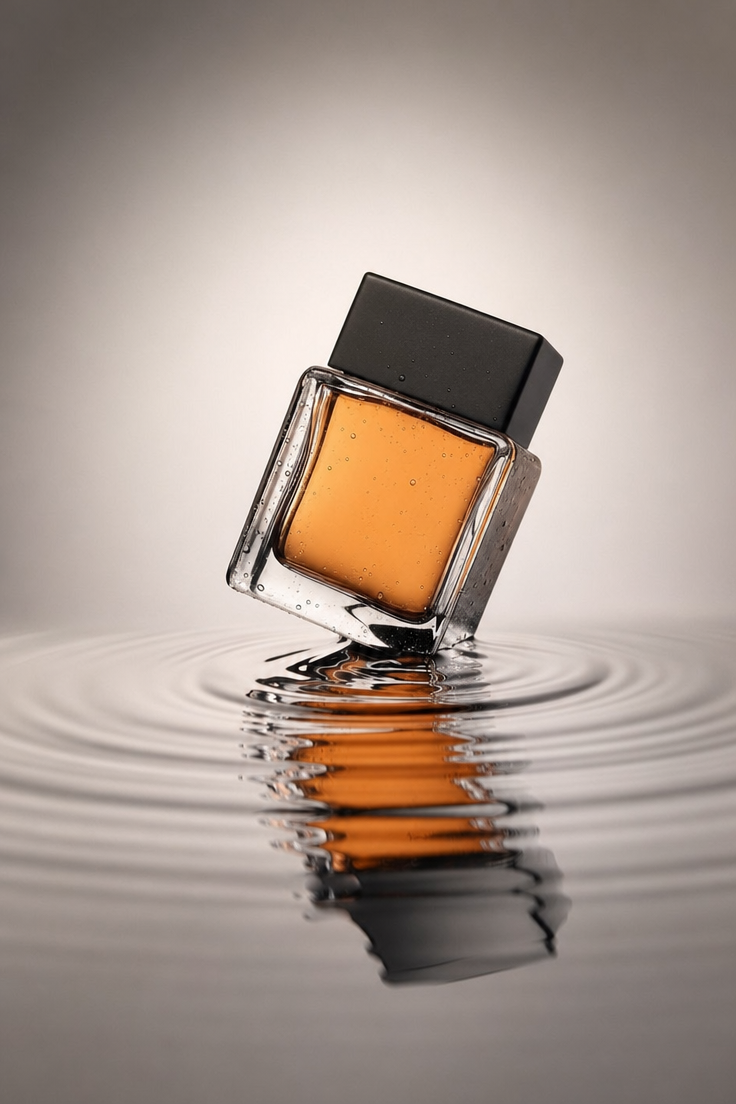
The centered composition comes directly from the “commercial product photography framing,” keeping the tilted square bottle as the visual anchor while the “crisp mirrored reflection” doubles its presence in the shallow water. “Soft diffused lighting” preserves the matte black cap and warm-gray background without harsh glare, while the orange warmth in the reflection and ripples adds controlled contrast to the black, gray, and orange palette. “Subtle droplets on the bottle edges” and “smooth concentric ripples” supply tactile detail without disrupting the clean, premium tone established by “clean minimal” and “premium luxury advertising aesthetic.”
FAQ
→How do I make the bottle feel more dramatic and dominant?
Replace “soft diffused lighting” with “hard directional side-lighting with deep shadows,” and change “centered” or “commercial product photography framing” to “low-angle close-up framing with the bottle filling most of the image.” Keep “crisp mirrored reflection” if you want the water to reinforce the bottle’s scale.
→How do I shift this from a warm luxury mood to a cooler, more futuristic one?
Replace “clean minimal warm-gray background” with “cool charcoal-gray studio background with subtle blue undertones,” and change the warm orange reflection to “controlled cyan highlights in the water.” Retain “matte black cap” and “soft diffused lighting,” but add “cool rim light along the bottle edges” for separation.
→How do I create a series of variations while keeping the same product-shot identity?
Keep “photorealistic studio product shot,” “sleek square men’s cologne bottle,” “premium luxury advertising aesthetic,” and “crisp mirrored reflection” unchanged. Swap only the setting phrase, such as “shallow water” for “polished black stone,” “wet slate,” or “fine sand with shallow grooves,” then replace “smooth concentric ripples” with the matching surface detail, such as “subtle mineral reflections” or “wind-shaped sand trails.”
Learn the technique behind this
- Why can't AI spell, and how do I get readable text in an image? — Older diffusion models had no character-level representation of text, so they produced letterform-shaped texture instead of words.
- How should a prompt be structured, and does word order matter? — A prompt that behaves predictably names one subject first, then what it is doing, then where, then the light, then the lens or medium, then the style.
- Do negative prompts work, and what should go in one? — Negative prompts work on models that support a separate negative conditioning channel — mainly Stable Diffusion and FLUX-family models.
Related prompts
Playful brunette beauty ad portrait
Red Lip Balm with Lychee Freshness
Premium wellness pouch with golden spices

Teal-Accented Bunny Toy Studio Portrait