Same prompt, generated with each model separately — click one to see how it holds up.
Why this works
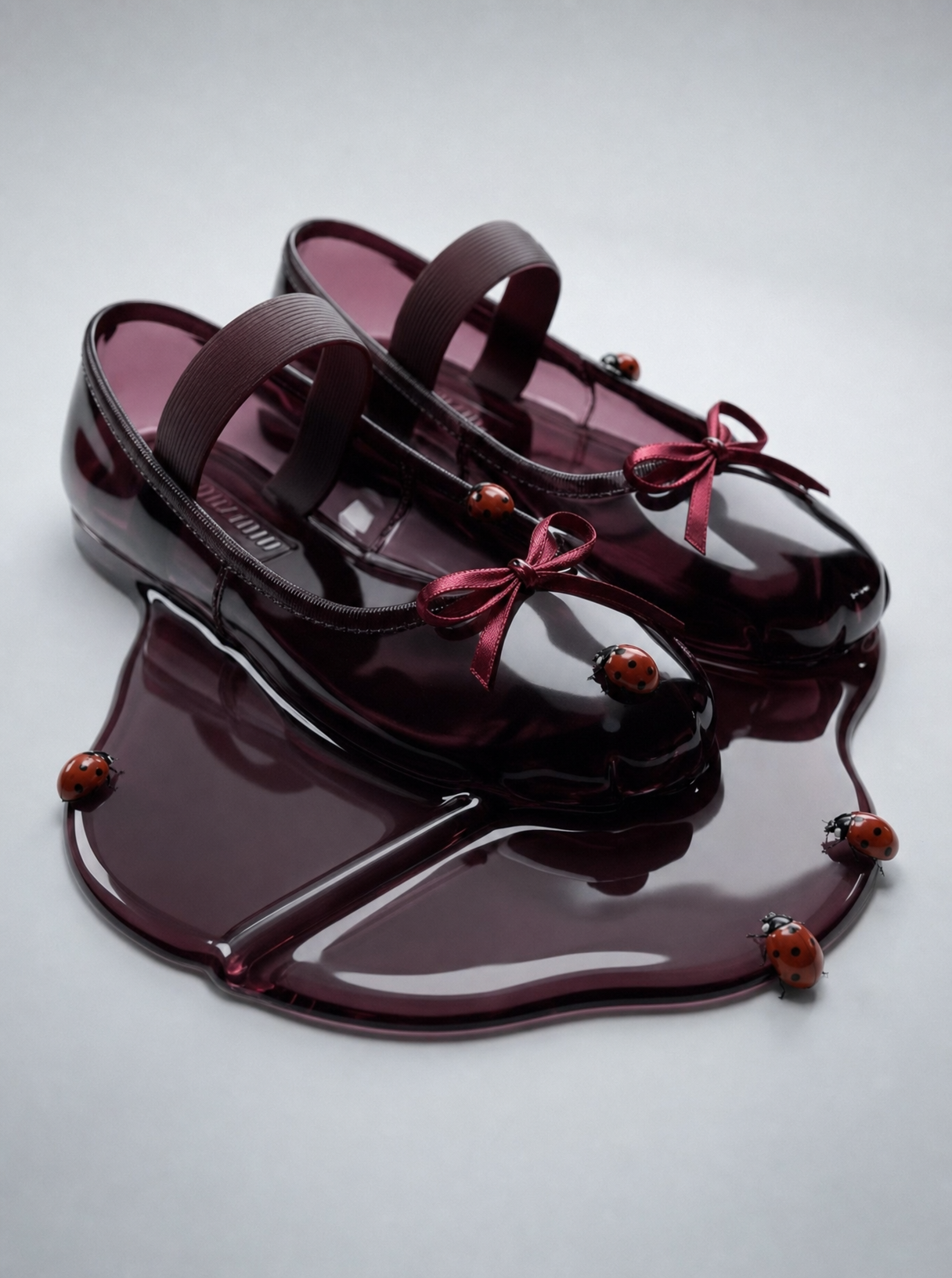
The centered product composition and “sharp focus” keep the paired Mary Jane shoes as the unmistakable subject, while the “minimalist cool-gray studio background” removes competing detail. “Translucent maroon,” “glossy clear material,” and “subtle specular highlights” produce the visible red-purple sheen and crisp reflections, with the “dark-red, liquid-like puddle base” extending that color into the lower frame. The “delicate ankle-strap bows,” “tiny ladybugs,” and explicit “whimsical modern mood” add playful scale and character without disrupting the clean, high-key fashion-still-life structure.
FAQ
→How do I make the shoes feel darker, moodier, and more luxurious?
Replace “clean high-key lighting” with “low-key directional lighting with deep shadows,” and change “minimalist cool-gray background” to “matte charcoal studio background.” Keep “glossy clear material” and “crisp reflections,” but add “controlled burgundy rim light” to preserve the translucent red surfaces while increasing contrast.
→How do I make the ladybugs and bows more visually prominent?
Replace “A few tiny ladybugs are scattered around the shoes” with “three detailed ladybugs perched on the ankle straps and puddle edge,” and change “delicate ankle-strap bows” to “oversized satin ankle-strap bows.” Add “shallow depth of field with the nearest bow and ladybug in sharp focus” while retaining “product-centered composition” so the shoes remain the main anchor.
→How do I turn this into a coordinated series of product images?
Keep the fixed phrases “photorealistic studio product shot,” “centered,” “minimalist cool-gray studio background,” and “clean high-key lighting,” then swap the subject phrase for variations such as “translucent cobalt slingback heels on a matching blue liquid-like puddle” or “amber translucent loafers on a glossy honey-colored base.” Replace “ladybugs” with one recurring motif, such as “tiny silver beetles,” to give every image a consistent visual signature.
Learn the technique behind this
- Why can't AI spell, and how do I get readable text in an image? — Older diffusion models had no character-level representation of text, so they produced letterform-shaped texture instead of words.
- How should a prompt be structured, and does word order matter? — A prompt that behaves predictably names one subject first, then what it is doing, then where, then the light, then the lens or medium, then the style.
- Do negative prompts work, and what should go in one? — Negative prompts work on models that support a separate negative conditioning channel — mainly Stable Diffusion and FLUX-family models.
Related prompts
Playful brunette beauty ad portrait
Red Lip Balm with Lychee Freshness
Premium wellness pouch with golden spices
Teal-Accented Bunny Toy Studio Portrait