Why this works
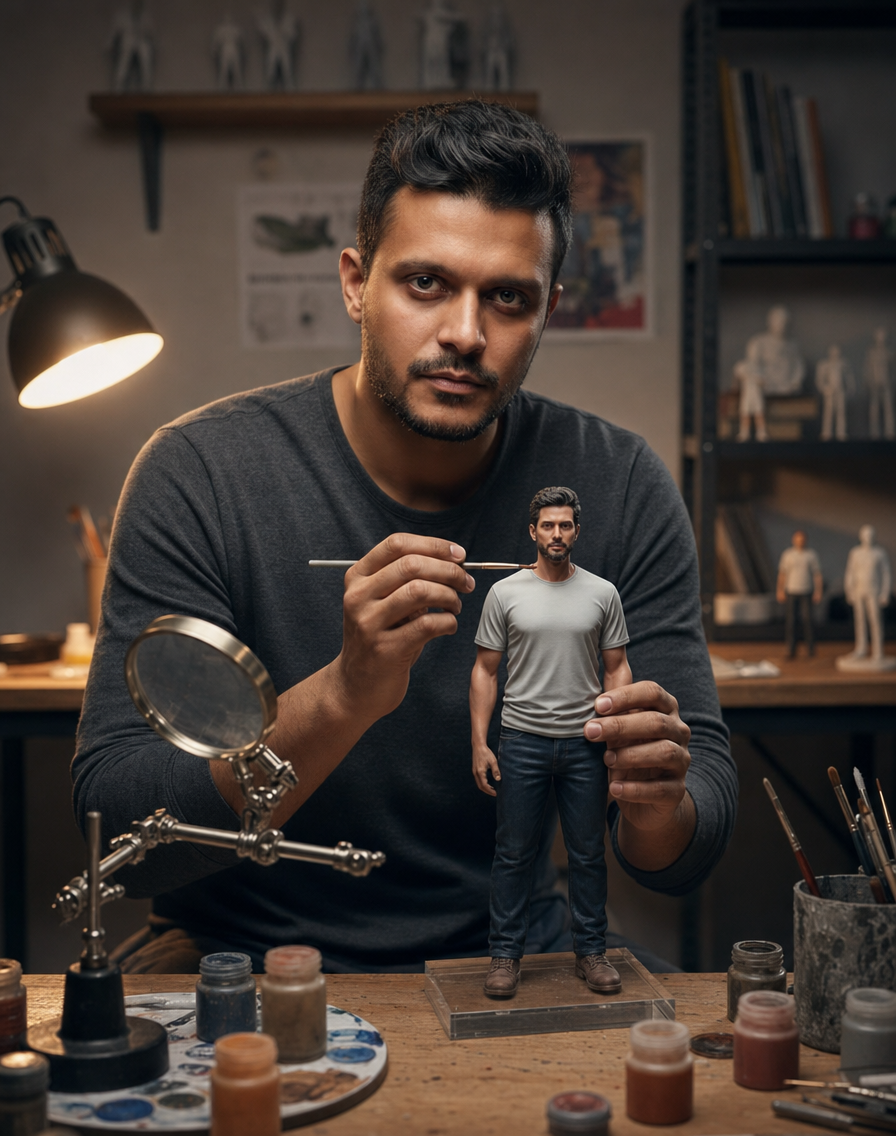
The intimate portrait-closeup is anchored by “cinematic studio framing, close intimate angle emphasizing hands and brushwork,” which makes the brush, fingers, and miniature the narrative center. “Warm desk lamp lighting” adds a focused, creative warmth, while “shallow depth of field” and “softly blurred background” separate the workbench action from the shelves and books. The charcoal-gray shirt and natural color palette reinforce the image’s dominant gray-and-black harmony, with “gentle highlights on the acrylic base” providing a precise visual accent.
FAQ
→How do I make the miniature more prominent than the painter’s hands?
Replace “close intimate angle emphasizing hands and brushwork” with “tight macro framing centered on the miniature and its acrylic base,” and change “the miniature stands on a clear acrylic base” to “the miniature fills the foreground as the dominant subject, with the painter softly receding behind it.” Keep “shallow depth of field” to blur the real man without losing the miniature’s detail.
→How do I shift this from a warm creative scene to a tense, dramatic one?
Replace “Warm desk lamp lighting creates gentle highlights” with “hard single-source side lighting with deep shadows and sharp highlights,” and replace “natural color palette” with “desaturated charcoal, black, and muted rust tones.” Changing “focused, creative, warm, intimate” to “tense, obsessive, cinematic” will reinforce the sharper emotional direction.
→How do I create a series of variations while keeping the self-portrait concept?
Keep “a man painting a miniature version of himself,” “showing the same facial features as the real person,” and “cinematic composition” unchanged, then swap the workbench action and environment: use “carving a miniature at a stone studio table,” “assembling a miniature in a bright model-making workshop,” or “displaying several painted self-portraits on a gallery plinth.” Match each variation with a targeted lighting phrase such as “cool overhead daylight,” “soft window light,” or “spotlit gallery lighting.”
Learn the technique behind this
- Why can't AI spell, and how do I get readable text in an image? — Older diffusion models had no character-level representation of text, so they produced letterform-shaped texture instead of words.
- Why does AI get hands and faces wrong, and how do I fix it? — Hands fail because they're small in frame, extremely variable in pose, and self-occluding — the model has less usable signal per pixel than for any other body part.
- How should a prompt be structured, and does word order matter? — A prompt that behaves predictably names one subject first, then what it is doing, then where, then the light, then the lens or medium, then the style.
Related prompts
Playful brunette beauty ad portrait
Red Lip Balm with Lychee Freshness
Premium wellness pouch with golden spices

Teal-Accented Bunny Toy Studio Portrait