Why this works
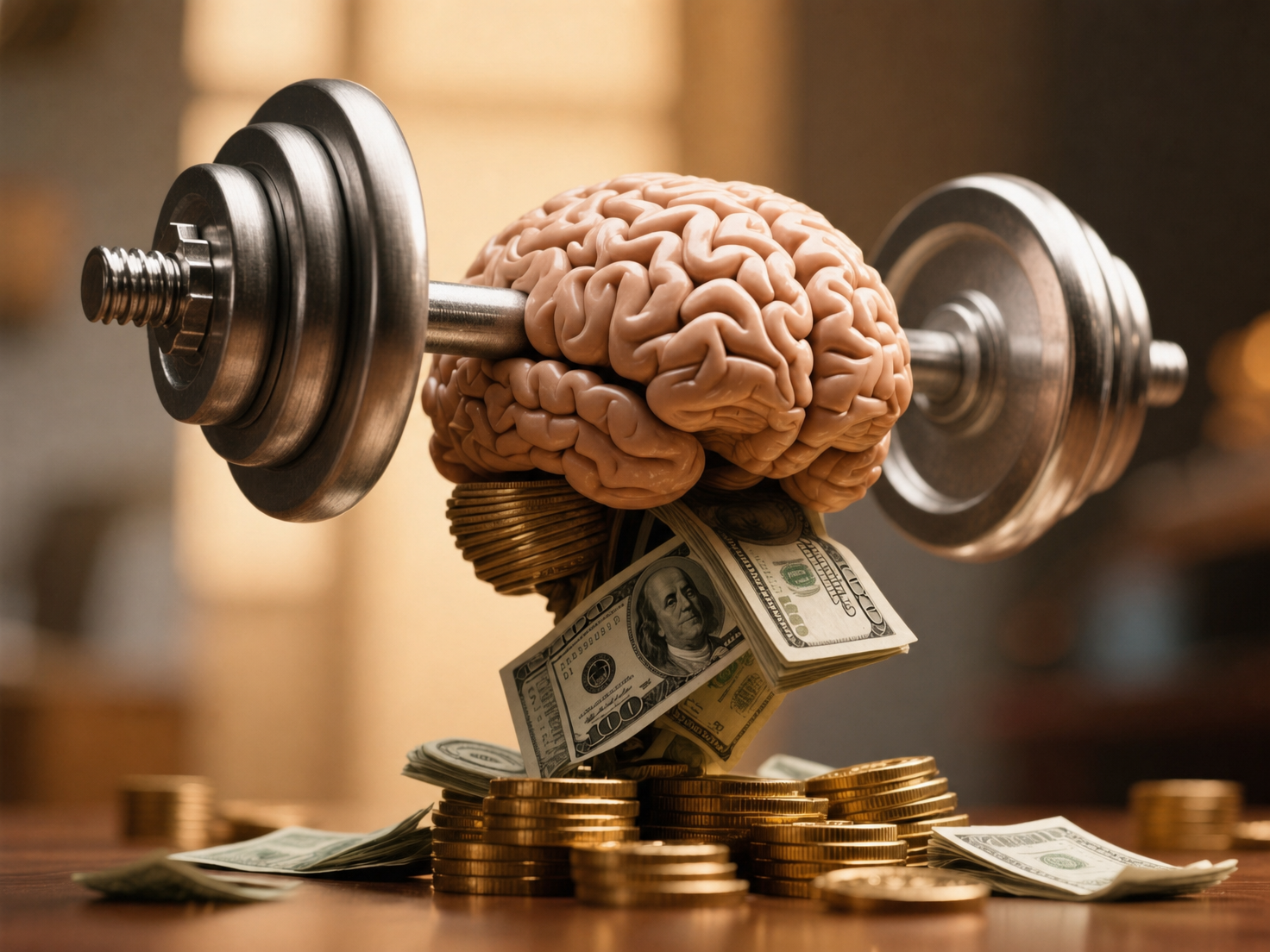
The centered studio framing and “brain integrated into the center of a chrome dumbbell barbell” make the brain the visual anchor, while “piles of gold coins” and “floating banknotes beneath it” create a clear downward hierarchy and a conceptual money-versus-mind read. “Warm cinematic key light with subtle rim highlights” supplies the cinematic mood, and “glossy metallic reflections” gives the barbell and coins their hard, premium surfaces; the requested “brushed steel” adjustment keeps those reflections controlled rather than mirror-flat. “Shallow depth of field” and “crisp focus on the brain and center barbell area” isolate the central object against the clean studio setup, while muted green and off-white notes add restrained contrast to the dominant beige, gold, and gray palette.
FAQ
→How do I make the brain feel more dominant and psychologically intense?
Replace “surrounded by tangible piles of gold coins and a few floating banknotes beneath it” with “small, widely spaced piles of gold coins and a few distant, softly blurred banknotes beneath it,” and change “shallow depth of field” to “very shallow depth of field with the brain in razor-sharp focus.” Add “deep shadow in the barbell interior and subtle vascular detail on the brain” to increase tension without changing the centered composition.
→How do I shift this from a polished financial concept to a darker, more ominous image?
Replace “warm cinematic key light with subtle rim highlights” with “low-key directional light with cold blue shadows and a narrow red rim light,” and replace “Clean studio setup” with “dark, minimal studio void with faint haze.” Change “glossy metallic reflections on the barbell and coins” to “restrained reflections with darkened metal and isolated specular highlights” so the gold and brushed steel retain definition without the product-shot brightness.
→How do I build a coherent variation series from this prompt using different concepts?
Keep “centered,” “studio product-shot aesthetic,” “shallow depth of field,” and “crisp focus on the brain and center barbell area” fixed across every image. Swap “a human brain integrated into the center of a chrome dumbbell barbell” for phrases such as “a human heart integrated into the center of a brushed steel barbell,” “an hourglass integrated into the center of a brushed steel barbell,” or “a glowing lightbulb integrated into the center of a brushed steel barbell,” while replacing “gold coins and floating banknotes” with matching symbolic objects such as “cracked clocks,” “scattered chess pieces,” or “loose electrical components.”
Learn the technique behind this
- Why can't AI spell, and how do I get readable text in an image? — Older diffusion models had no character-level representation of text, so they produced letterform-shaped texture instead of words.
- How should a prompt be structured, and does word order matter? — A prompt that behaves predictably names one subject first, then what it is doing, then where, then the light, then the lens or medium, then the style.
- Do negative prompts work, and what should go in one? — Negative prompts work on models that support a separate negative conditioning channel — mainly Stable Diffusion and FLUX-family models.
Related prompts
Playful brunette beauty ad portrait
Red Lip Balm with Lychee Freshness
Premium wellness pouch with golden spices

Teal-Accented Bunny Toy Studio Portrait