Why this works
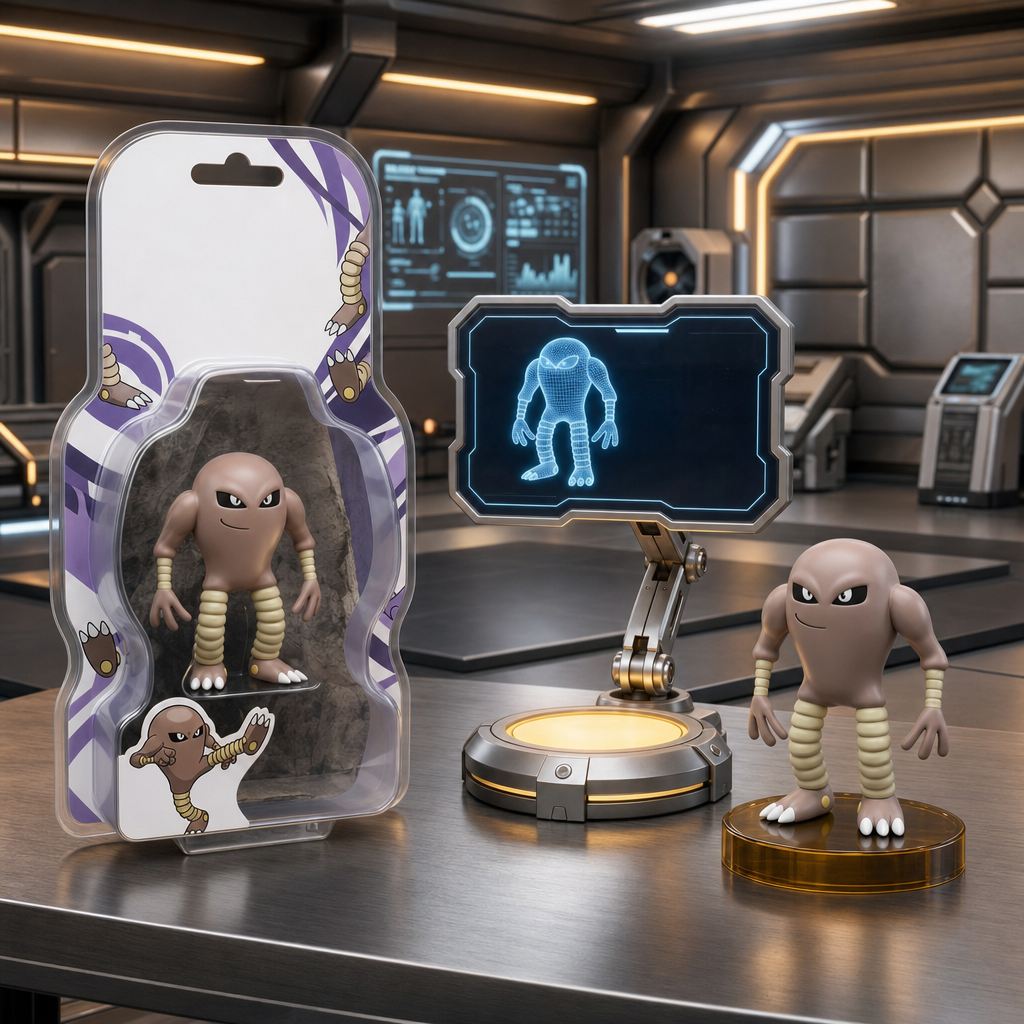
The centered composition and gold/purple/blue palette trace directly back to naming those colors in the prompt: 'purple swirl artwork' on the packaging, 'glowing amber circular pedestal' for the gold, and 'blue-toned schematic silhouette' for the sky-blue accent. 'Displayed in blister packaging... standing next to the unboxed figurine' is what forces the symmetrical, side-by-side product-shot arrangement rather than a dynamic action pose. The sense of scale and tech-showcase mood comes from 'mechanical arm holding a holographic display card showing... technical specs', which adds a second focal point competing with the figure itself, while 'chrome paneling' and 'holographic screens' in the background push the sci-fi lab read instead of a generic toy-store shelf. 'Sharp focus' and 'cinematic lighting' are the two words doing the heavy lifting on image clarity and the warm rim-light look on the figure's tan elastic body.
FAQ
→How do I make the holographic schematic card the main subject instead of the figure?
Move it to the front of the prompt and add size/detail language: change 'displayed in blister packaging with purple swirl artwork, standing next to the unboxed figurine' to something like 'a large holographic display card floating center-frame showing a detailed blue-toned schematic silhouette with glowing technical specs, dwarfing the small action figure beside it'. Also add 'shallow depth of field on the card, figure slightly out of focus' to the camera description so focus follows the new subject.
→How do I shift this from a sleek sci-fi mood to something grittier or more worn?
Swap 'futuristic sci-fi laboratory with chrome paneling, holographic screens, and brushed metal desk surface' for 'cluttered retro workshop with scratched metal panels, dim flickering fluorescent tubes, and a dusty workbench'. Also replace 'glowing amber circular pedestal' with 'rusted turntable stand' and drop 'cinematic lighting' in favor of 'harsh overhead lighting with visible dust particles' to kill the premium showcase feel.
→How do I turn this into a series of different creature figures using the same setup?
Keep the entire setting and camera block fixed ('futuristic sci-fi laboratory', 'glowing amber circular pedestal', 'mechanical arm holding a holographic display card', 'product photography style, sharp focus, cinematic lighting') and only vary the subject clause. Replace 'bipedal fighting creature with a tan elastic-looking body, long kangaroo-like legs, and a confident smirk' with new descriptors each time, like 'a four-armed insectoid warrior with chitinous blue plating and a snarling expression' or 'a stout rock-textured brawler with glowing red cracks and a stoic gaze', so the packaging and pedestal act as a consistent frame across the set.
Learn the technique behind this
- Why can't AI spell, and how do I get readable text in an image? — Older diffusion models had no character-level representation of text, so they produced letterform-shaped texture instead of words.
- Why does the model ignore parts of my prompt? — Ignored instructions are almost always conflicts, counts, or spatial relationships — three things current models handle badly — rather than the model failing to read you.
- How should a prompt be structured, and does word order matter? — A prompt that behaves predictably names one subject first, then what it is doing, then where, then the light, then the lens or medium, then the style.
Related prompts
Playful brunette beauty ad portrait
Red Lip Balm with Lychee Freshness
Premium wellness pouch with golden spices
Teal-Accented Bunny Toy Studio Portrait