Why this works
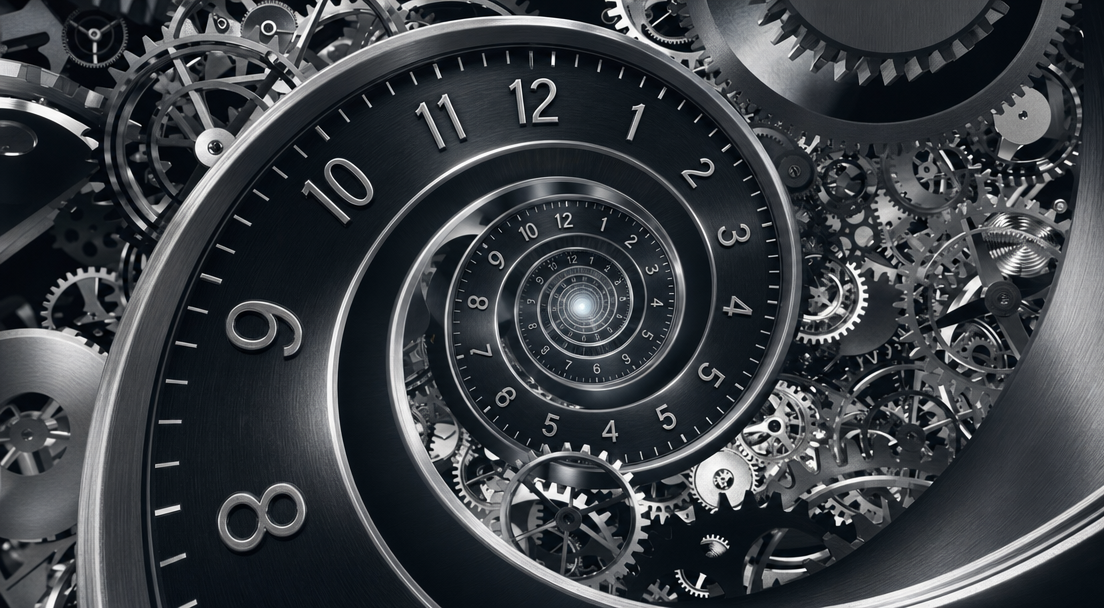
The centered tunnel perspective and “concentric clock faces” make the eye travel inward through a controlled spiral, while “interlocking gears” supplies repeated circular rhythm and a clear mechanical subject. “High-contrast monochrome” locks the palette to black and white, and “cooler gunmetal and brushed steel with subtle brushed highlights” adds material variation without breaking that restraint. The mood comes from the specific combination of “hypnotic, dramatic, enigmatic,” “endless motion,” and “crisp reflections,” which turns the precise photorealistic CGI detail into something ominous and surreal.
FAQ
→How do I change this prompt to make the image feel warmer and less ominous?
Replace “high-contrast monochrome” and “cooler gunmetal and brushed steel” with “deep bronze, tarnished copper, and warm ivory tones,” and replace “dramatic, enigmatic” with “ornate, inviting, and nostalgic.” Change “crisp reflective highlights” to “soft amber illumination with gentle diffuse reflections” to reduce the severe contrast.
→How do I make one clock face the dominant focal point instead of the entire spiral?
Replace “concentric clock faces” and “centrally framed tunnel perspective pulling inward” with “one oversized clock face in the foreground, centered and occupying most of the frame, with smaller gears receding behind it.” Add “sharpest focus on the central dial and Arabic numerals, background components progressively blurred” so the primary clock clearly outranks the surrounding machinery.
→How do I build a related series while keeping this visual identity?
Keep “photorealistic CGI,” “high-contrast monochrome,” “intricate metallic detail,” and “centered tunnel perspective,” then vary only the structural subject phrase, such as “interlocking astrolabes,” “spiraling mechanical lungs,” or “concentric planetary orreries.” Preserve “Arabic numeral dial markings” for clock-themed variations, or replace it with a consistent identifying detail such as “etched geometric calibration marks” across every non-clock design.
Learn the technique behind this
- Why can't AI spell, and how do I get readable text in an image? — Older diffusion models had no character-level representation of text, so they produced letterform-shaped texture instead of words.
- How should a prompt be structured, and does word order matter? — A prompt that behaves predictably names one subject first, then what it is doing, then where, then the light, then the lens or medium, then the style.
- Do negative prompts work, and what should go in one? — Negative prompts work on models that support a separate negative conditioning channel — mainly Stable Diffusion and FLUX-family models.
Related prompts
Playful brunette beauty ad portrait
Red Lip Balm with Lychee Freshness
Premium wellness pouch with golden spices
Teal-Accented Bunny Toy Studio Portrait