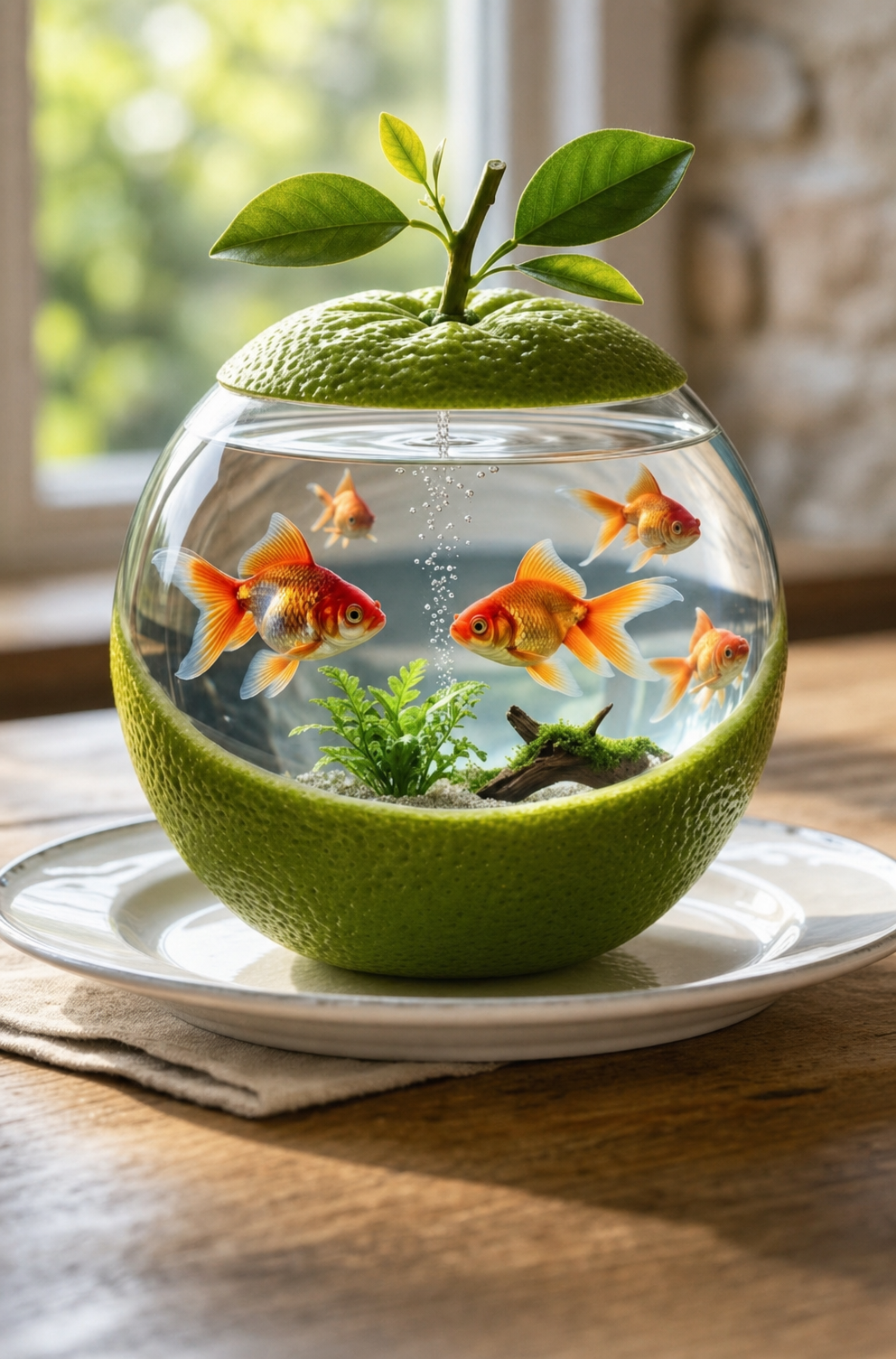
Same prompt, generated with each model separately — click one to see how it holds up.
Why this works
The phrase “glossy green orange reimagined as a transparent aquarium” creates the central surreal contradiction, while “centered” macro-like product framing makes the fruit-tank immediately legible. “Warm soft window light,” “crisp reflections,” and “delicate refractions through the glass-like walls” produce the polished highlights and gold-orange color harmony visible against the white plate and gray-brown table. “Shallow depth of field” keeps attention on the goldfish, bubbles, and intact textured peel while softening the rustic setting behind them.
FAQ
→How do I make the goldfish more central and prominent?
Replace “several ultra-realistic goldfish swimming gracefully” with “one large ultra-realistic goldfish facing the viewer at the center of the aquarium,” and change “shallow depth of field” to “sharp focus across the fish’s eyes, scales, and surrounding water.” Keep “centered” framing so the enlarged fish becomes the visual anchor.
→How do I shift the image from dreamy and polished to eerie and mysterious?
Replace “Warm soft natural window light” with “cold directional moonlight with deep shadows,” and replace “dreamy polished look” with “ominous, uncanny still-life mood.” Change “white ceramic plate” to “a cracked black ceramic plate” and add “darkened rustic table with faint condensation” to reduce the bright, cheerful contrast.
→How do I build a series of variations while keeping the same concept?
Keep “transparent aquarium” and “peel remains intact and realistic outside the tank” unchanged, then swap the subject phrase “glossy green orange” for alternatives such as “yellow lemon,” “striped watermelon,” or “purple fig.” Replace “small green aquatic plant” with setting-specific details such as “coral branches,” “floating duckweed,” or “delicate sea grass,” while preserving “macro-like product framing” and “ultra-sharp focus on reflections and refractions” for visual continuity.
Learn the technique behind this
- Why can't AI spell, and how do I get readable text in an image? — Older diffusion models had no character-level representation of text, so they produced letterform-shaped texture instead of words.
- Do negative prompts work, and what should go in one? — Negative prompts work on models that support a separate negative conditioning channel — mainly Stable Diffusion and FLUX-family models.
- How should a prompt be structured, and does word order matter? — A prompt that behaves predictably names one subject first, then what it is doing, then where, then the light, then the lens or medium, then the style.
Related prompts

Playful brunette beauty ad portrait
Red Lip Balm with Lychee Freshness
Premium wellness pouch with golden spices

Teal-Accented Bunny Toy Studio Portrait