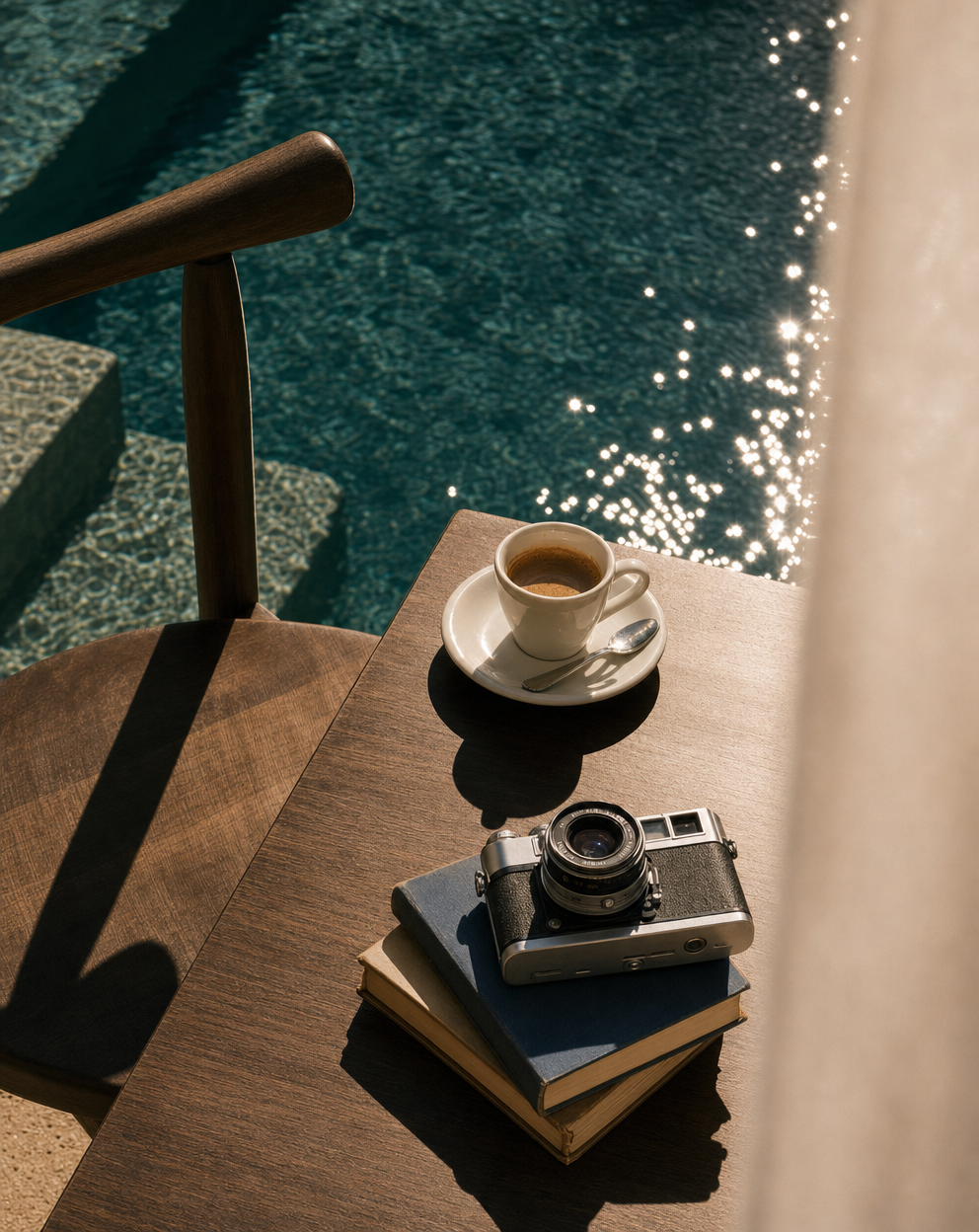
Same prompt, generated with each model separately — click one to see how it holds up.
Why this works
The relaxed luxury mood comes from the combined phrases “golden-hour sunlight with long, soft shadows” and “Relaxed luxury resort atmosphere,” while the deep teal pool adds a cool counterpoint to the dominant brown wood, beige book spines, and white ceramic. “Natural candid composition” and the rule-of-thirds placement keep the cup, camera, and table from feeling staged, and “shallow depth of field” makes the foreground still life read sharply against a softened pool backdrop. The prompt’s “high-detail textures on wood grain, ceramic glaze, and leather/metal camera accents” supplies tactile contrast across the warm, neutral palette.
FAQ
→How do I make the vintage camera the main focal point?
Replace “a white ceramic coffee cup with a matching saucer and a small spoon rests near the edge; beside it, a vintage film camera lies” with “a vintage film camera dominates the center foreground, its lens facing the viewer, while a white coffee cup and saucer sit farther back.” Change “shallow depth of field” to “tight focus on the camera lens with the cup softly blurred” and add “camera centered at the rule-of-thirds intersection.”
→How do I make the scene feel cooler and more modern instead of warm and nostalgic?
Replace “golden-hour sunlight with long, soft shadows” with “cool overcast daylight with clean, diffuse illumination,” and change “warm serene luxurious tone” to “minimal contemporary resort tone.” Replace “worn spines” with “sleek monochrome book covers” while keeping “deep teal swimming pool” to preserve the strongest cool color anchor.
→How do I build a series of variations while keeping the same visual identity?
Keep the fixed phrases “photorealistic lifestyle photography,” “natural candid composition,” “shallow depth of field,” “golden-hour sunlight,” and “deep teal swimming pool,” then swap only the still-life objects and texture clause. For example, replace “a vintage film camera lies on a neatly arranged stack of books” with “a linen-bound travel journal and tortoiseshell sunglasses rest on a neatly arranged stack of books,” and change “leather/metal camera accents” to “linen weave, paper edges, and polished tortoiseshell accents.”
Learn the technique behind this
- Why can't AI spell, and how do I get readable text in an image? — Older diffusion models had no character-level representation of text, so they produced letterform-shaped texture instead of words.
- How should a prompt be structured, and does word order matter? — A prompt that behaves predictably names one subject first, then what it is doing, then where, then the light, then the lens or medium, then the style.
- Do negative prompts work, and what should go in one? — Negative prompts work on models that support a separate negative conditioning channel — mainly Stable Diffusion and FLUX-family models.
Related prompts
Playful brunette beauty ad portrait
Red Lip Balm with Lychee Freshness
Premium wellness pouch with golden spices

Teal-Accented Bunny Toy Studio Portrait