Why this works
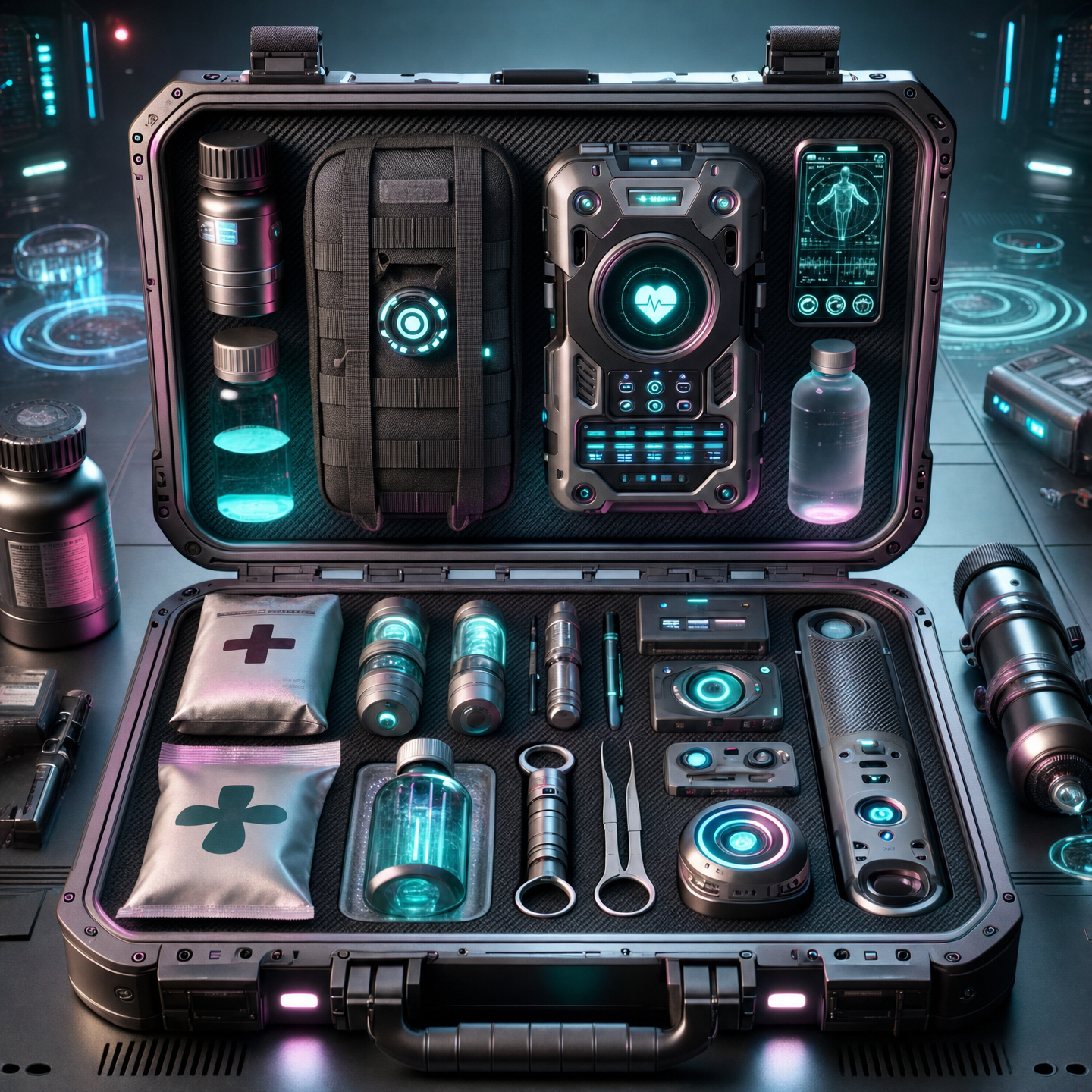
The centered product-shot framing makes the opened case the immediate subject, while “sharp focus and shallow depth of field” keeps the organized supplies legible against a softened background. “Soft magenta and teal edge illumination instead of cyan” supplies the distinctive pink-teal color harmony, and “cinematic cool lighting with a magenta rim glow” reinforces the clean, futuristic clinical mood. Material specificity in “textured carbon-fiber panels,” “visible metal latches,” and “brushed aluminum tabletop” gives the gray composition convincing industrial texture and controlled reflections.
FAQ
→How do I make the diagnostic device the most prominent element?
Replace “a compact diagnostic device showing a subtle heart-like medical icon” with “a prominent diagnostic device in the foreground, its illuminated heart-monitor interface facing the camera,” and change “centered” framing to “centered composition with the diagnostic device in the visual center.” Reduce the case-wide emphasis by replacing “compartments neatly organized” with “organized compartments radiating around the diagnostic device.”
→How do I change the clean clinical mood into a tense emergency atmosphere?
Replace “clean sci-fi product photography look” and “cinematic cool lighting” with “high-stakes emergency medical scene, harsh directional lighting, deep shadows, and intermittent red warning illumination.” Change “soft magenta and teal edge illumination” to “sharp red and blue emergency strobes,” while keeping “ultra-detailed realistic materials” to preserve the photorealistic finish.
→How do I create a matching series with different medical kits?
Keep the fixed visual language, including “brushed aluminum tabletop,” “soft magenta and teal edge illumination,” “clean sci-fi product photography look,” “sharp focus,” and “shallow depth of field.” Swap “futuristic medical first aid kit case” and its contents for variants such as “portable surgical trauma kit with sterile instruments,” “compact field diagnostic kit with sensor modules,” or “advanced neonatal emergency kit with pediatric supplies,” while retaining “hard-shell suitcase design with textured carbon-fiber panels and visible metal latches” for continuity.
Learn the technique behind this
- Why can't AI spell, and how do I get readable text in an image? — Older diffusion models had no character-level representation of text, so they produced letterform-shaped texture instead of words.
- How should a prompt be structured, and does word order matter? — A prompt that behaves predictably names one subject first, then what it is doing, then where, then the light, then the lens or medium, then the style.
- Do negative prompts work, and what should go in one? — Negative prompts work on models that support a separate negative conditioning channel — mainly Stable Diffusion and FLUX-family models.
Related prompts
Playful brunette beauty ad portrait
Red Lip Balm with Lychee Freshness
Premium wellness pouch with golden spices
Teal-Accented Bunny Toy Studio Portrait