Why this works
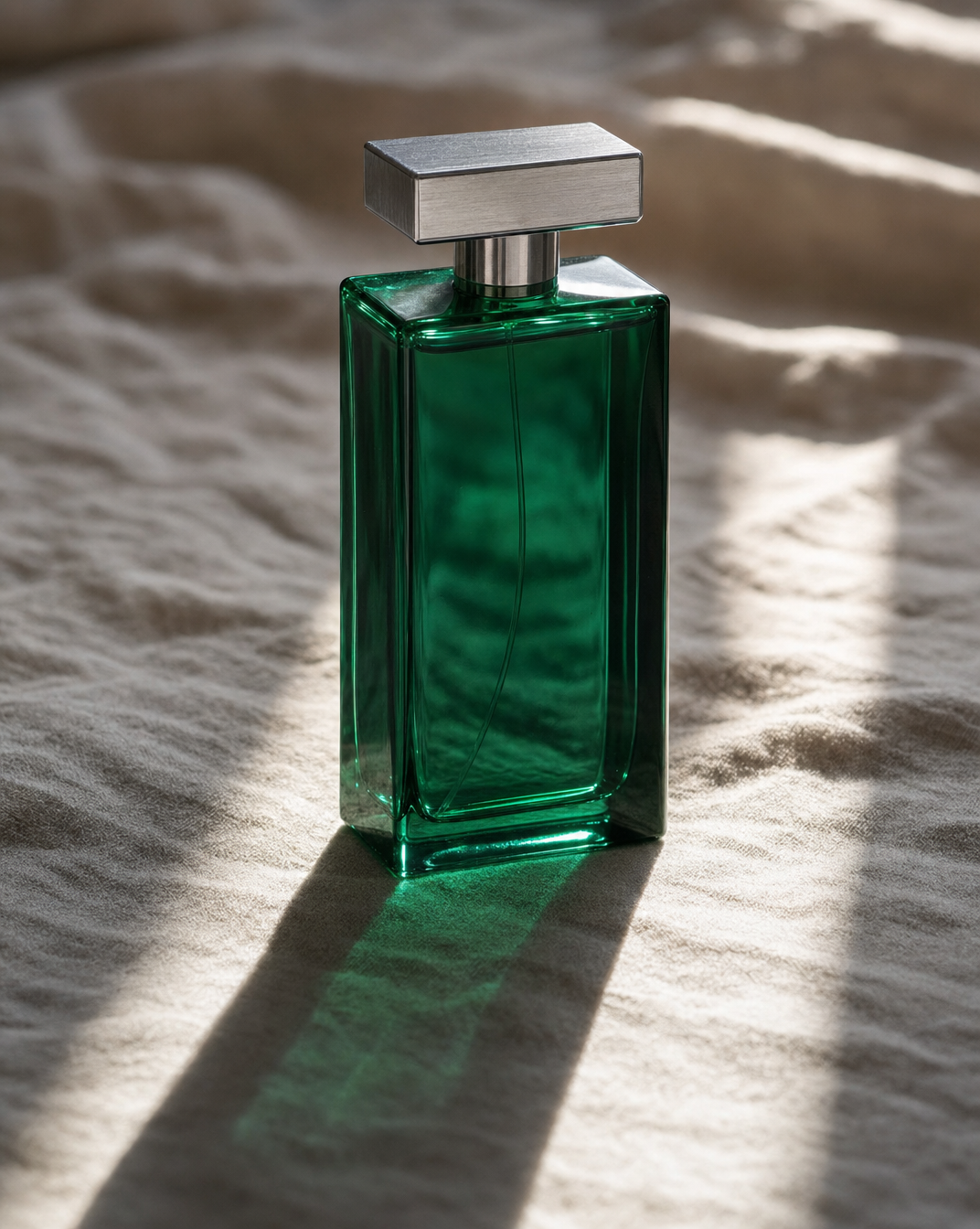
“Cinematic macro product framing” and the centered composition make the emerald-green bottle the immediate focal point, while “shallow depth of field” keeps the rumpled off-white linen softly subordinate. “Early morning sunlight streaming from the side” supplies the warm directional mood, and “long, dramatic, crisp shadows” gives the centered object graphic weight across the beige-gray linen. The phrase “brushed silver cap catching a subtle lens flare,” reinforced by “fine dust motes drifting through the beam,” adds small specular and atmospheric details that support the premium editorial fragrance aesthetic without competing with the bottle.
FAQ
→How do I make the perfume bottle feel more prominent and imposing?
Replace “centered composition” with “low-angle three-quarter product framing with the bottle dominating the foreground,” and change “cinematic macro product framing” to “extreme macro framing, bottle filling 70% of the image.” Keep “shallow depth of field” to preserve the soft linen background, but add “sharp focus on the emerald glass and silver cap.”
→How do I shift this from warm morning luxury to a cooler, mysterious mood?
Replace “early morning sunlight streaming from the side” with “cool moonlight entering from a narrow side window,” and change “luxurious warm dramatic mood” to “moody nocturnal luxury.” Replace “off-white French linen sheets” with “charcoal silk fabric” and remove “fine dust motes drifting through the beam” in favor of “faint blue haze around the bottle.”
→How do I create a coordinated series of variations from this image?
Keep the fixed phrases “premium editorial fragrance advertising aesthetic,” “photorealistic, highly detailed,” and “cinematic macro product framing,” then vary only the setting and light: use “black marble slab with hard studio spotlight,” “pale limestone with soft overcast daylight,” or “deep burgundy velvet with a narrow amber rim light.” Preserve “translucent emerald-green perfume bottle” and “brushed silver cap” so the bottle remains the series anchor.
Learn the technique behind this
- Why can't AI spell, and how do I get readable text in an image? — Older diffusion models had no character-level representation of text, so they produced letterform-shaped texture instead of words.
- How should a prompt be structured, and does word order matter? — A prompt that behaves predictably names one subject first, then what it is doing, then where, then the light, then the lens or medium, then the style.
- Do negative prompts work, and what should go in one? — Negative prompts work on models that support a separate negative conditioning channel — mainly Stable Diffusion and FLUX-family models.
Related prompts
Playful brunette beauty ad portrait
Red Lip Balm with Lychee Freshness
Premium wellness pouch with golden spices
Teal-Accented Bunny Toy Studio Portrait