Why this works
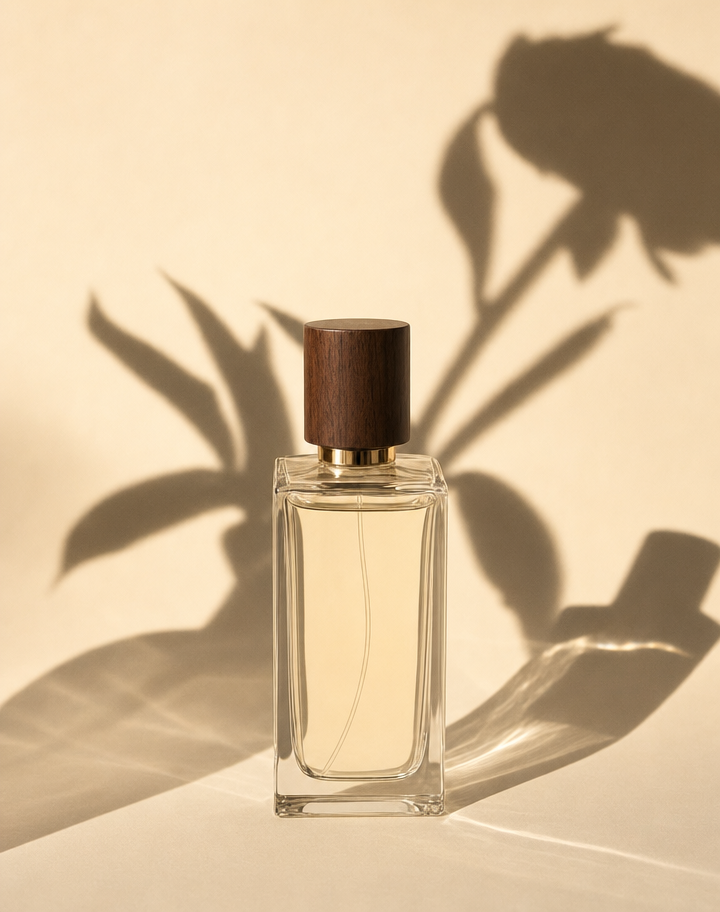
The centered product-photography framing and “crisp focus on bottle glass and highlights” make the square-shouldered bottle the unmistakable focal point, while the dark walnut cap and thin gold collar supply the brown, black, and warm tan accents visible against the restrained background. “Warm late-afternoon sunlight with slightly deeper contrast” gives the ivory-beige studio scene its warm, elegant tone, and “soft botanical shadows” adds organic pattern without disrupting the minimalist composition. “Subtle reflections and refractions through the glass” plus “crisp specular highlights” provide the controlled gray and pale tonal variation that makes the clear bottle read as premium glass rather than a flat silhouette.
FAQ
→How do I make the perfume bottle feel more dramatic and luxurious?
Replace “warm late-afternoon sunlight with slightly deeper contrast” with “hard directional sunset light with deep sculptural shadows and bright rim highlights,” and change “minimal ivory-beige studio background” to “dark charcoal stone backdrop.” Keep “crisp specular highlights” to preserve the glass’s polished finish while increasing separation from the background.
→How do I make the cap or gold collar more prominent?
Replace “centered product photography framing” with “slightly low-angle close-up framing that emphasizes the cap and neck,” and change “crisp focus on bottle glass and highlights” to “deep focus on the walnut cap, gold collar, and upper glass shoulders.” Adding “thin warm rim light tracing the collar” will make the gold detail read more clearly.
→How do I turn this into a coordinated series of perfume images?
Keep “premium editorial product photography,” “centered composition,” and “clean studio look” fixed, then swap the bottle description and palette for controlled variants such as “amber glass bottle with brushed silver cap” or “frosted blush glass bottle with pale stone cap.” Change “soft botanical shadows” to matching motifs such as “fern shadows,” “olive branch shadows,” or “geometric window shadows,” while retaining “warm late-afternoon sunlight” for consistent lighting across the series.
Learn the technique behind this
- Why can't AI spell, and how do I get readable text in an image? — Older diffusion models had no character-level representation of text, so they produced letterform-shaped texture instead of words.
- Do negative prompts work, and what should go in one? — Negative prompts work on models that support a separate negative conditioning channel — mainly Stable Diffusion and FLUX-family models.
- How should a prompt be structured, and does word order matter? — A prompt that behaves predictably names one subject first, then what it is doing, then where, then the light, then the lens or medium, then the style.
Related prompts
Playful brunette beauty ad portrait
Red Lip Balm with Lychee Freshness
Premium wellness pouch with golden spices
Teal-Accented Bunny Toy Studio Portrait