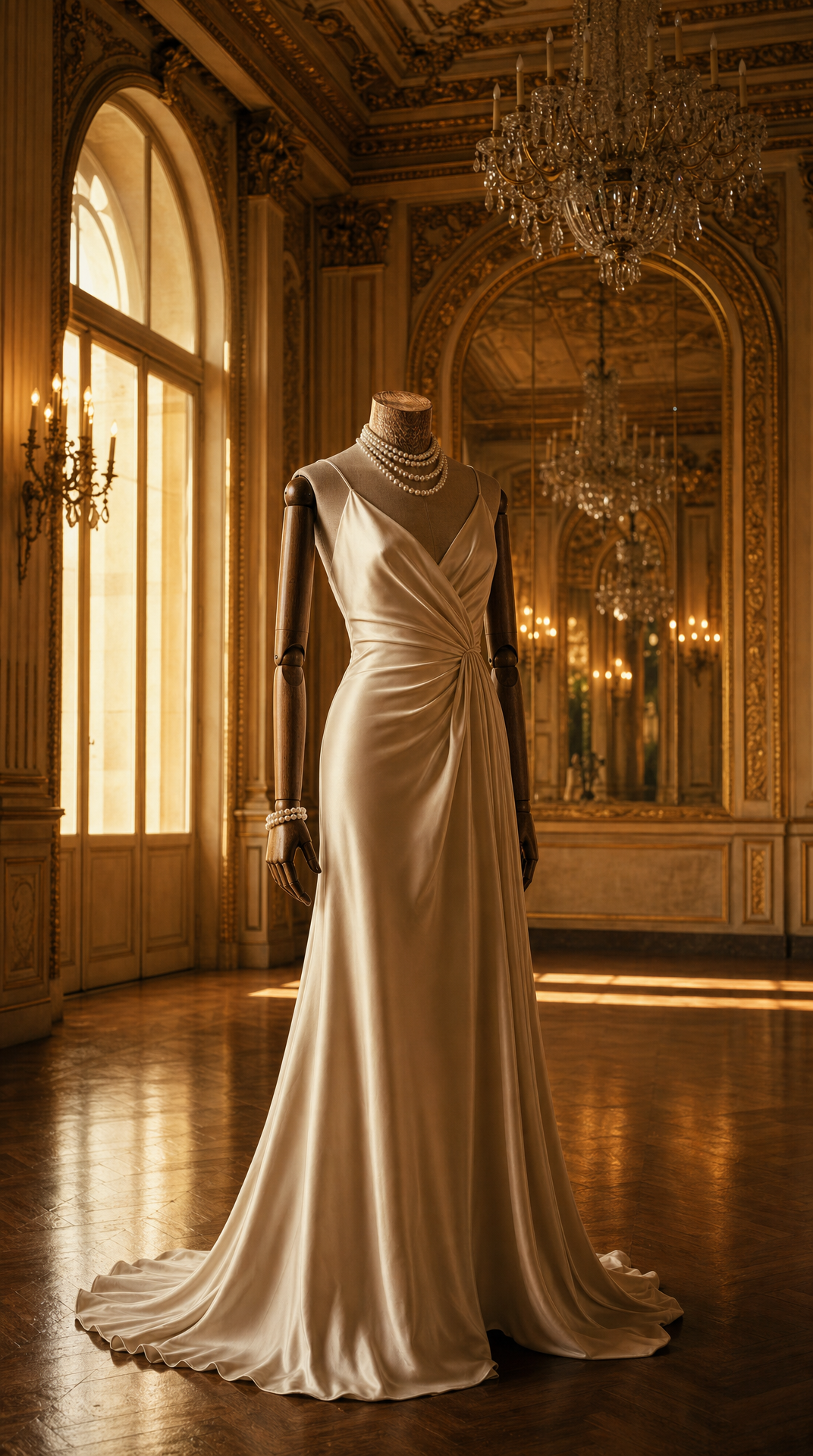
Same prompt, generated with each model separately — click one to see how it holds up.
Why this works
The gold, tan and brown palette in the actual render traces directly back to 'rich sepia-toned color grading' and 'soft warm golden hour lighting filtering through tall windows' - those two phrases are doing the color work, not just the ivory gown. 'Three-quarter profile angle showcasing the full silhouette' is why the composition reads as portrait-full-body with the gown's shape fully legible instead of cropped or frontal. The gilded mirrors and crystal chandeliers from the setting description are what let 'luminous highlights' actually register as scattered points of light rather than a flat glow, giving the image its sense of scale inside a large room. 'Luxurious nostalgic atmosphere' is the phrase pulling the mood toward moody and mysterious rather than bright and cheerful, since it's paired with sepia tones instead of clear daylight language.
FAQ
→How do I make the lighting feel colder or more clinical instead of nostalgic?
Swap 'soft warm golden hour lighting filtering through tall windows' for something like 'cold blue-white fluorescent lighting from overhead panels' and drop 'rich sepia-toned color grading' in favor of 'desaturated cool-toned color grading'. That removes the gold cast entirely and pushes the palette toward blue and grey.
→How do I shift focus onto the pearl accessories instead of the whole gown?
Change the camera line from 'three-quarter profile angle showcasing the full silhouette' to 'close-up angle framing the neckline and pearl accessories in sharp detail'. You'll also want to trim 'full silhouette' language from the subject description so the composition doesn't fight the tighter crop.
→How do I turn this into a series with different decades or eras?
Keep 'sleek female mannequin' and the lighting/color phrases fixed, then swap 'ornate 1920s ballroom with gilded mirrors and crystal chandeliers' for era-specific settings like 'minimalist 1960s mod lounge with chrome furniture' or 'opulent 1980s disco hall with mirrored walls', and update the gown description ('ivory satin gown with pearl accessories') to match, like 'metallic silver mini dress with geometric jewelry'.
Learn the technique behind this
- Why can't AI spell, and how do I get readable text in an image? — Older diffusion models had no character-level representation of text, so they produced letterform-shaped texture instead of words.
- How should a prompt be structured, and does word order matter? — A prompt that behaves predictably names one subject first, then what it is doing, then where, then the light, then the lens or medium, then the style.
- Do negative prompts work, and what should go in one? — Negative prompts work on models that support a separate negative conditioning channel — mainly Stable Diffusion and FLUX-family models.
Related prompts
Playful brunette beauty ad portrait
Red Lip Balm with Lychee Freshness
Premium wellness pouch with golden spices
Teal-Accented Bunny Toy Studio Portrait