Why this works
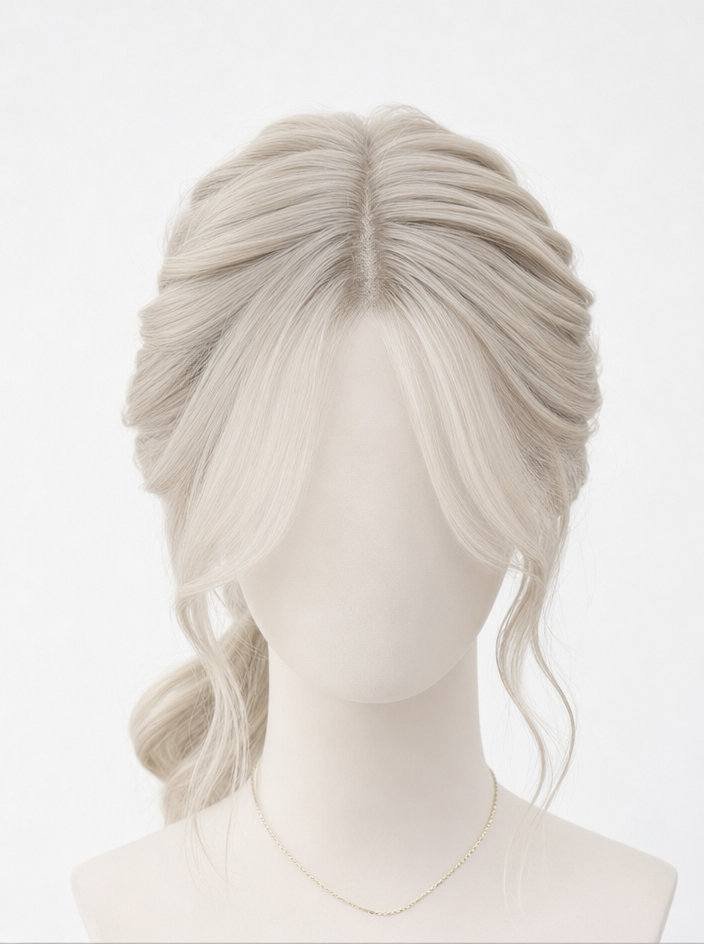
The single dominant beige tone in the render traces directly back to 'cool diffused studio lighting' and 'soft white background,' which flatten the color range and let the 'subtle ash-toned lowlights' read as texture rather than contrast. 'Close-up' plus 'sleek low ponytail with twisted sections and face-framing wispy strands' is what forces the eye to the hair's construction instead of the mannequin's face, giving the image its portrait-closeup composition. The 'delicate gold chain necklace visible below' is the one warm accent in an otherwise cool palette, and that single word choice, 'delicate,' keeps it a supporting detail rather than a competing focal point. Without 'professional hairstyling photography' anchoring the style modifiers, the same wig description could easily drift toward editorial fashion rather than the clinical, instructional look this image has.
FAQ
→How do I make the necklace a bigger focal point instead of an afterthought?
Move it earlier in the sentence and add descriptive weight: change 'a delicate gold chain necklace visible below' to 'a statement gold chain necklace draped prominently at the collarbone, catching the studio light' and consider swapping 'Close-up of a mannequin head' to 'Close-up of a mannequin head and shoulders' so there's room in frame for it to register.
→How do I shift this from a clinical studio look to a warmer, editorial mood?
Replace 'cool diffused studio lighting' with 'warm golden-hour rim lighting' and swap 'soft white background' for 'soft terracotta or blush backdrop.' You'd also want to drop 'ash-toned lowlights' in favor of 'honey-toned lowlights' so the hair color palette matches the new lighting instead of fighting it.
→How do I turn this into a series with different hair colors or styles?
Keep 'Close-up of a mannequin head wearing a...wig' and 'cool diffused studio lighting, soft white background, professional hairstyling photography' fixed as your template, then swap only the wig description: try 'copper red wig styled in a voluminous braided updo' or 'jet black wig in a sleek blunt bob with a middle part.' Keeping the lighting and background phrases identical across the set is what makes the variations feel like one cohesive catalog.
Learn the technique behind this
- Why can't AI spell, and how do I get readable text in an image? — Older diffusion models had no character-level representation of text, so they produced letterform-shaped texture instead of words.
- How should a prompt be structured, and does word order matter? — A prompt that behaves predictably names one subject first, then what it is doing, then where, then the light, then the lens or medium, then the style.
- Which aspect ratio should I use, and how does it change the image? — Aspect ratio determines what the model composes, not how it's cropped afterwards.
Related prompts
Playful brunette beauty ad portrait
Red Lip Balm with Lychee Freshness
Premium wellness pouch with golden spices
Teal-Accented Bunny Toy Studio Portrait