Why this works
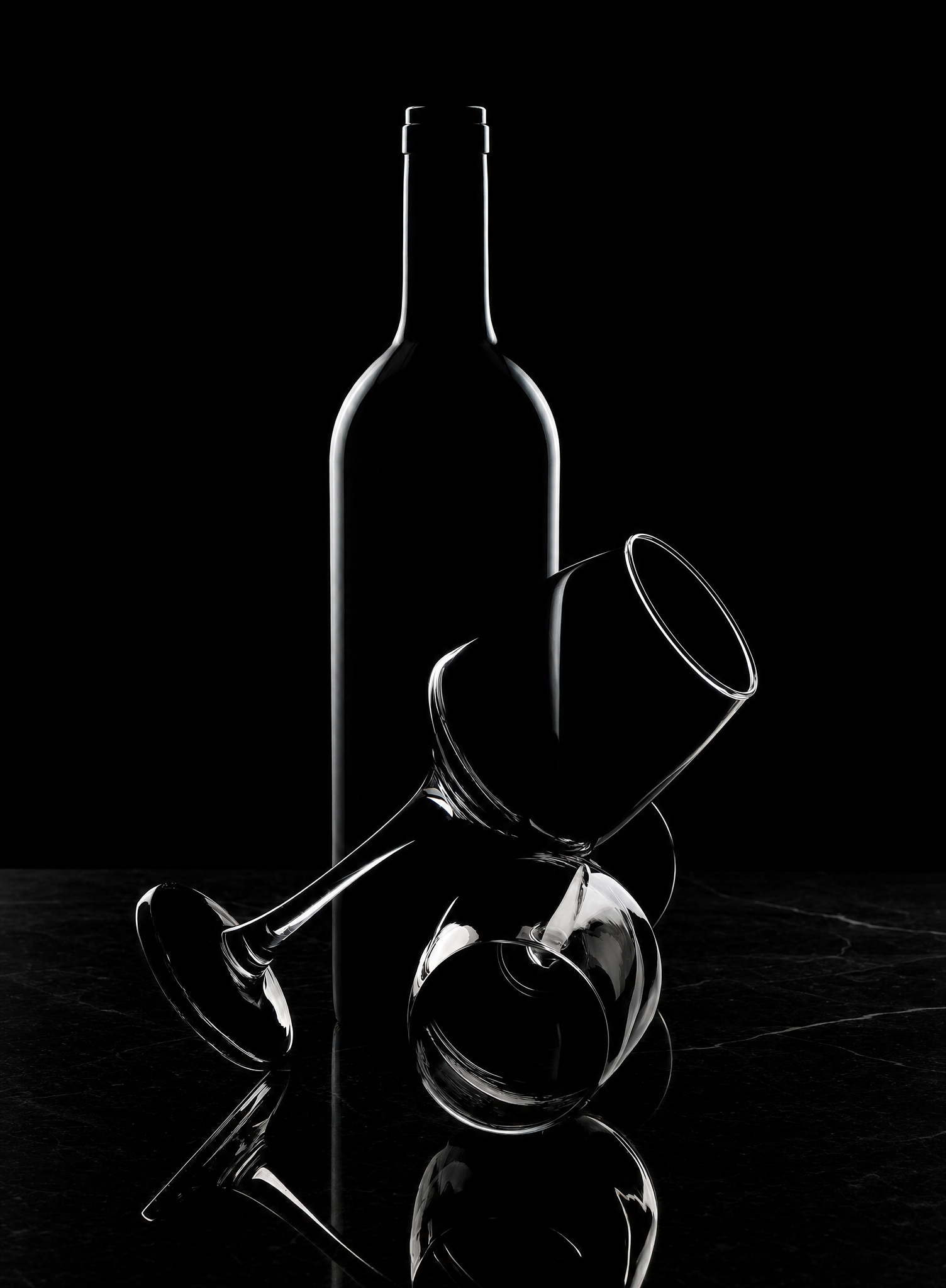
The phrase “dark wine bottle silhouetted behind several overturned wine glasses” establishes the layered, centered still-life structure, while “centered framing” keeps the bottle and glass shapes visually locked in place. “Crisp rim lighting” and “cool specular highlights” separate the transparent glass from the “deep blacks,” producing the image’s dominant gray-and-white tonal range and sharp reflective edges. “Shallow depth of field” concentrates focus on the foreground glass while allowing the silhouetted bottle to recede, reinforcing the prompt’s moody, minimalist luxury tone.
FAQ
→How do I change this prompt to make the wine bottle the main focal point?
Replace “dark wine bottle silhouetted behind several overturned wine glasses” with “dark wine bottle standing prominently in the center, with two overturned wine glasses receding to the sides,” and change “shallow depth of field” to “sharp focus across the bottle and label, softer focus on the foreground glasses.”
→How do I make the image warmer and more inviting instead of cool and dramatic?
Replace “cool specular highlights” and “deep blacks with cool specular highlights” with “warm amber rim lighting and golden highlights,” and change “moody, elegant minimalist luxury composition” to “warm, intimate wine-cellar still life with inviting evening atmosphere.”
→How do I build a coordinated series of variations from this prompt?
Keep “photorealistic studio still life,” “centered framing,” and “glossy black surface” unchanged, then swap the subject phrase for controlled alternatives such as “amber whiskey bottle behind cut-crystal tumblers,” “clear gin bottle behind overturned cocktail glasses,” or “champagne bottle behind tall flutes,” while replacing “wine” references in the mood and prop descriptions to match each variation.
Learn the technique behind this
- Why can't AI spell, and how do I get readable text in an image? — Older diffusion models had no character-level representation of text, so they produced letterform-shaped texture instead of words.
- How should a prompt be structured, and does word order matter? — A prompt that behaves predictably names one subject first, then what it is doing, then where, then the light, then the lens or medium, then the style.
- Which aspect ratio should I use, and how does it change the image? — Aspect ratio determines what the model composes, not how it's cropped afterwards.
Related prompts
Playful brunette beauty ad portrait
Red Lip Balm with Lychee Freshness
Premium wellness pouch with golden spices
Teal-Accented Bunny Toy Studio Portrait