Why this works
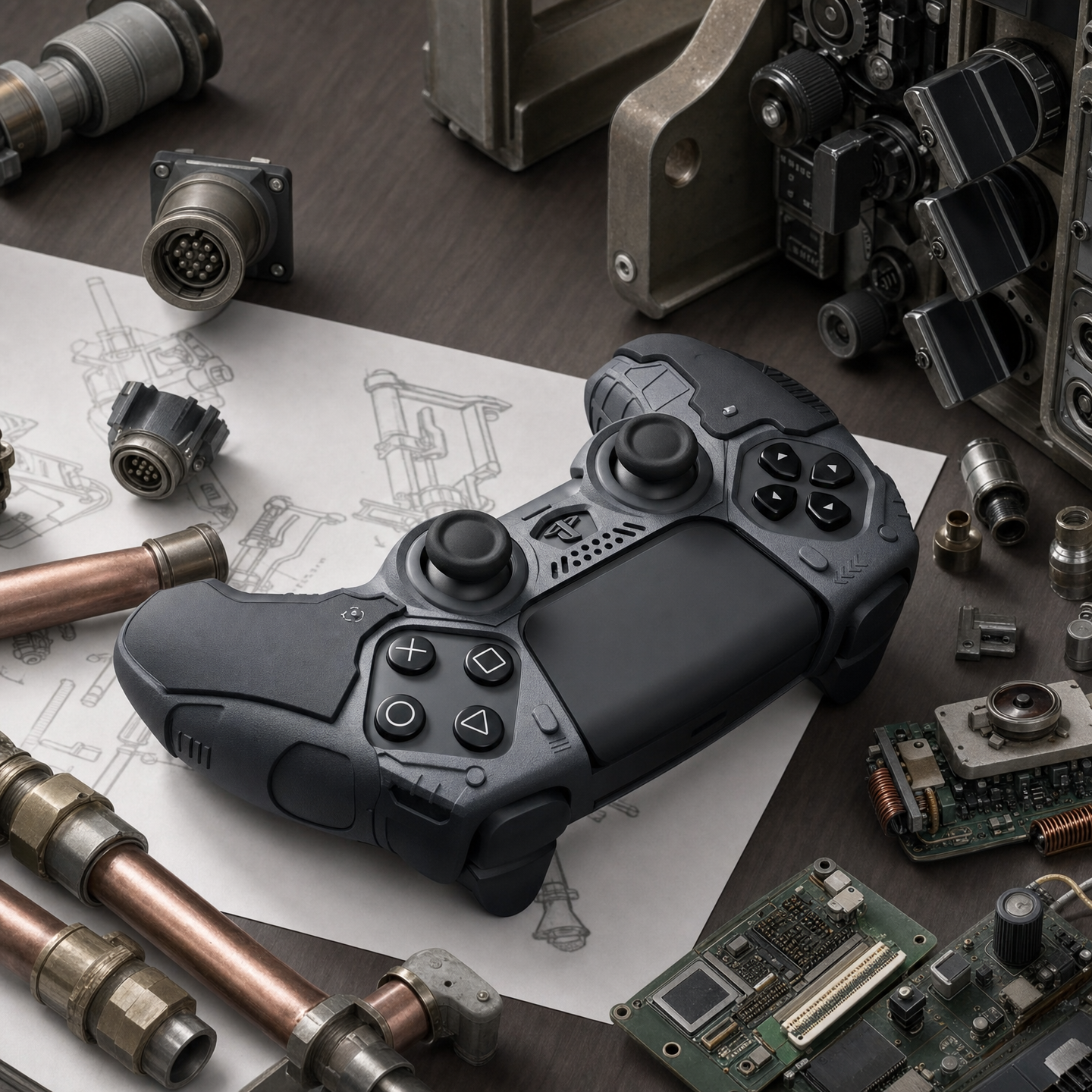
“Futuristic dark-slate game controller” gives the overhead flatlay a clear visual anchor, while “scattered copper and silver mechanical parts and small circuit boards” supplies controlled technical context without competing with the subject. “Top-down angled composition” establishes the graphic overhead framing, and “soft diffused lighting” plus “subtle cyan rim highlights” keeps reflections readable across the controller’s “sleek matte and glossy materials.” The generated image’s black controller against brown, beige, and tan workbench tones creates restrained contrast, while “crisp sharp detail” and “realistic reflections” make the small components feel tactile and product-photography precise.
FAQ
→How do I make the controller more central and visually dominant?
Replace “scattered copper and silver mechanical parts and small circuit boards around it” with “a sparse ring of copper and silver parts placed far from the controller,” and add “controller centered, occupying most of the frame, unobstructed silhouette.” Keep “top-down angled composition” so the stronger subject emphasis does not change the basic framing.
→How do I shift this from a cool technical image to a warmer industrial mood?
Replace “cool neutral color palette with subtle cyan rim highlights” with “warm amber and rust palette with restrained orange rim highlights,” and change “soft, diffused studio lighting” to “low warm side-lighting with deeper directional shadows.” Retain “dark-slate” and “copper” to preserve the controller’s material contrast.
→How do I create a consistent series using different controllers or workbench layouts?
Keep the fixed structure “Photorealistic studio product shot,” “top-down angled composition,” “soft diffused studio lighting,” “crisp sharp detail,” and “no visible text or labels.” Swap only “futuristic dark-slate game controller” for variants such as “retro cream arcade controller” or “transparent neon handheld controller,” then replace the accessory phrase with a repeatable set such as “scattered brass gears and labeled circuit boards,” while keeping the same camera and lighting language.
Learn the technique behind this
- Why can't AI spell, and how do I get readable text in an image? — Older diffusion models had no character-level representation of text, so they produced letterform-shaped texture instead of words.
- How do I keep one consistent style across a whole set of images? — Style consistency is more achievable than character consistency because style lives in describable attributes.
- How should a prompt be structured, and does word order matter? — A prompt that behaves predictably names one subject first, then what it is doing, then where, then the light, then the lens or medium, then the style.
Related prompts
Playful brunette beauty ad portrait

Red Lip Balm with Lychee Freshness
Premium wellness pouch with golden spices

Teal-Accented Bunny Toy Studio Portrait