Why this works
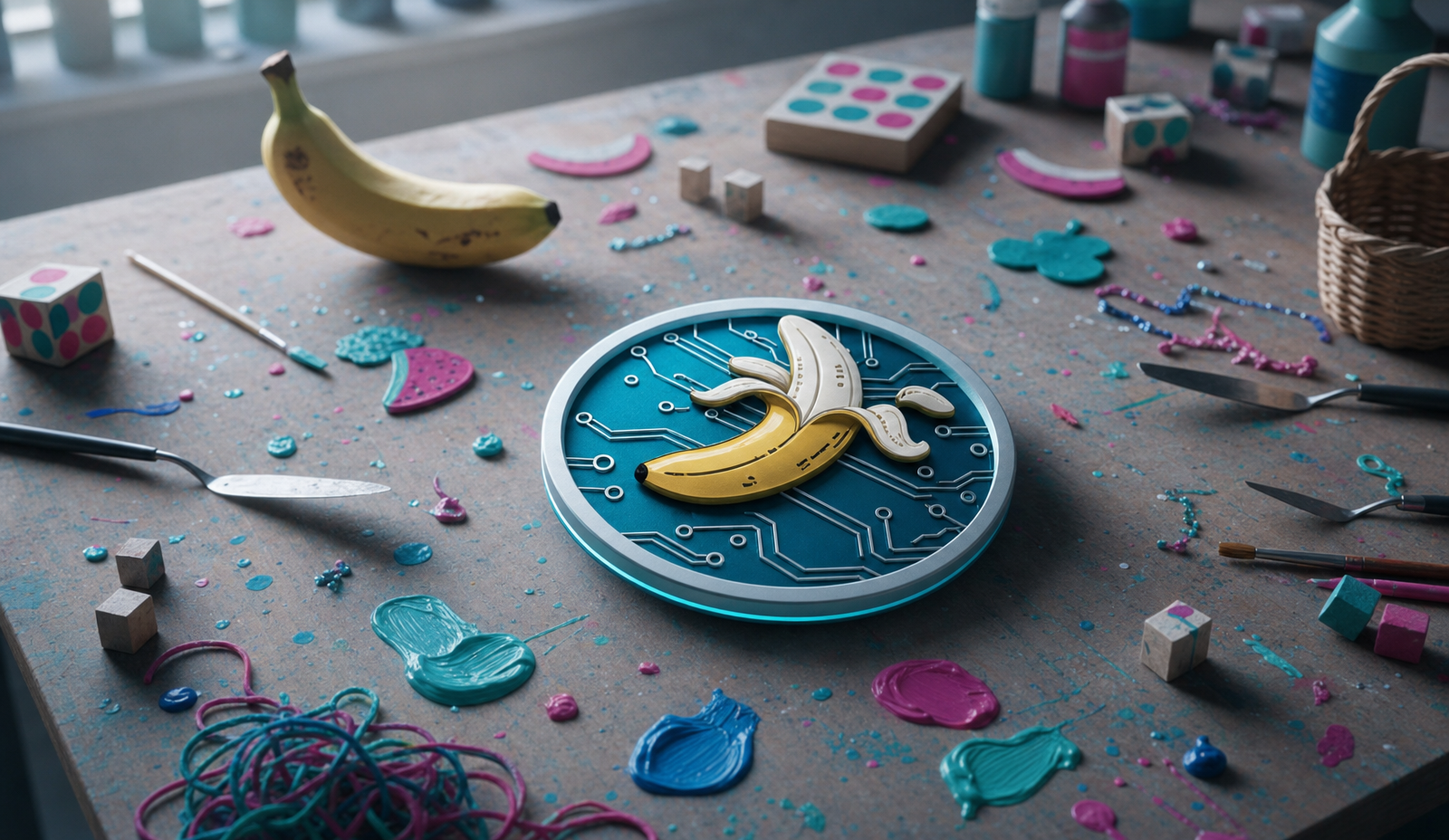
The phrase “banana-themed 3D logo badge at the center” establishes a clear focal point, while “cinematic close-up composition” and the overhead-flatlay layout keep the medallion readable against the workbench. “Soft diffused side light from a nearby window” produces the gentle, controlled mood, and “crisp highlights and smooth materials” give the badge and glossy paint blobs a polished product-render finish. The “cool-toned glowing circular medallion” and “subdued teal and magenta hues,” balanced by the loose banana’s yellow, explain the teal, pink, blue, and yellow color harmony without letting the surrounding scraps overpower the logo.
FAQ
→How do I make the peeled-banana emblem more prominent?
Replace “banana-themed 3D logo badge at the center” with “an oversized peeled-banana emblem dominating the center, with the circular medallion partially visible behind it,” and change “cinematic close-up composition” to “tight macro close-up focused on the emblem.” Reduce “craft scraps” and “miniature toy components” to “sparse peripheral craft scraps” so the secondary objects move out of competition.
→How do I change the playful scene into a darker, more dramatic version?
Replace “whimsical, playful, bright” with “moody, surreal, theatrical,” and change “Soft diffused side light from a nearby window” to “hard directional side light with deep shadows and a narrow spotlight on the medallion.” Replace “cooler warm-neutral palette” with “deep teal, bruised magenta, charcoal, and isolated banana yellow” while keeping “crisp highlights” for controlled reflective accents.
→How do I build a series of variations with different fruit logos?
Replace every banana-specific phrase, including “banana-themed,” “peeled-banana emblem,” and “loosely placed banana,” with a fruit template such as “strawberry-themed 3D logo badge,” “stylized strawberry emblem,” and “a loose strawberry on the workbench.” Keep “glowing circular medallion,” “craft-strewn workbench,” “shallow depth of field,” and “highly detailed polished 3D render” unchanged so the fruit remains the only major variable across the series.
Learn the technique behind this
- Why can't AI spell, and how do I get readable text in an image? — Older diffusion models had no character-level representation of text, so they produced letterform-shaped texture instead of words.
- How should a prompt be structured, and does word order matter? — A prompt that behaves predictably names one subject first, then what it is doing, then where, then the light, then the lens or medium, then the style.
- Do negative prompts work, and what should go in one? — Negative prompts work on models that support a separate negative conditioning channel — mainly Stable Diffusion and FLUX-family models.
Related prompts
Playful brunette beauty ad portrait
Red Lip Balm with Lychee Freshness
Premium wellness pouch with golden spices
Teal-Accented Bunny Toy Studio Portrait