Why this works
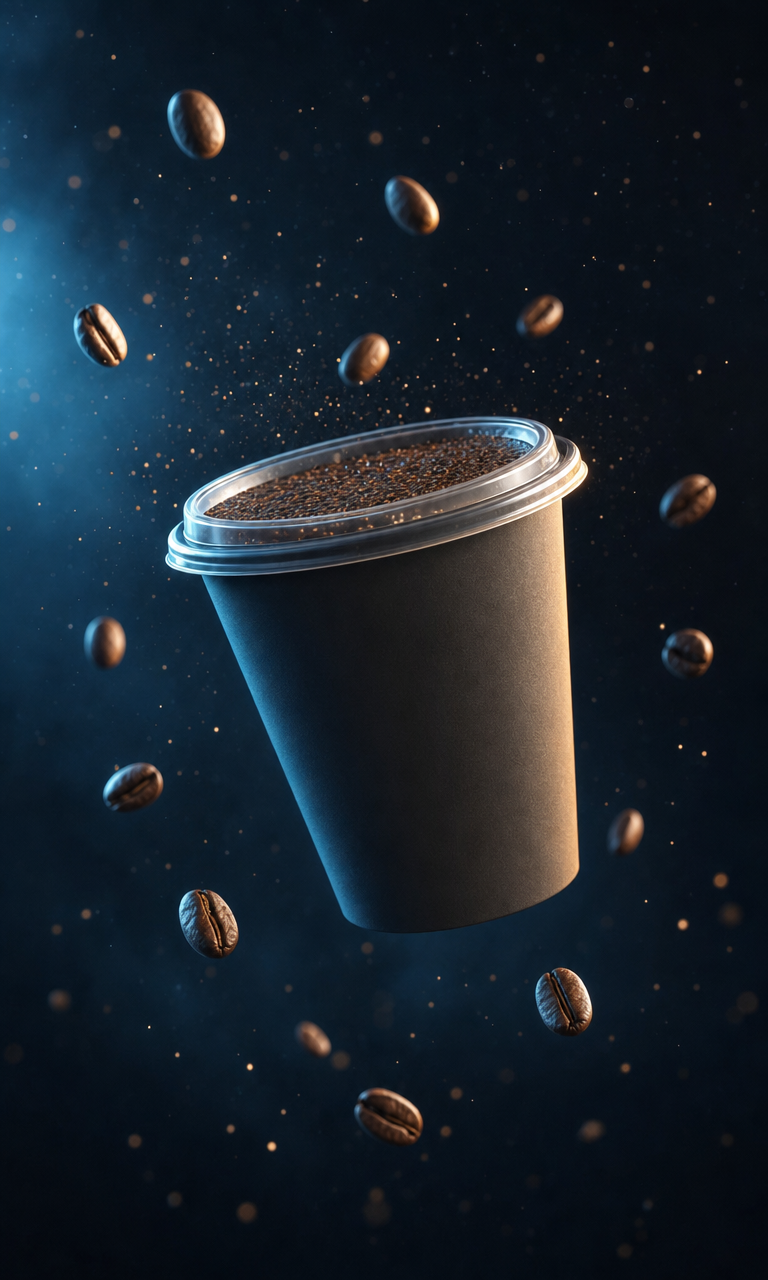
The centered, product-focused framing and “single disposable coffee cup floating in outer space” make the cup the unmistakable anchor, while the “loose halo” of suspended beans adds scale without competing with it. The “matte charcoal-black” cup, brown beans, and “cool blue key light with a faint warm rim light” create a restrained black-brown-blue harmony with a premium cinematic mood. “Shallow bokeh starfield background” and “gentle depth-of-field falloff” keep distant space soft, while “hyper-detailed bean texture,” “subtle oily highlights,” and “high micro-contrast” reserve sharpness for the foreground materials.
FAQ
→How do I make the coffee cup feel more luxurious and less ominous?
Replace “matte charcoal-black paper cup” with “deep espresso-brown cup with a satin finish and refined embossed branding,” and replace “premium dramatic cinematic mood” with “warm luxurious editorial mood.” Change the “cool blue key light” to “soft amber key light” while keeping the “faint warm rim light” for a warmer, hospitality-oriented palette.
→How do I make the coffee beans more central and prominent?
Replace “surrounded by coffee beans suspended in a loose halo” with “a dense spiral of coffee beans wrapping around the cup, with several beans in the foreground,” and change “clean product-focused framing” to “cup-and-bean composition with beans occupying the outer thirds.” Reduce “shallow bokeh” slightly to “moderate depth of field” so the nearest bean textures remain readable.
→How do I turn this into a consistent series of floating beverage products?
Keep “360-degree product-style view,” “centered” composition, “cool blue key light with a faint warm rim light,” and “shallow bokeh starfield background” unchanged as the visual template. Replace “single disposable coffee cup” and “coffee beans” with a fixed subject pair for each variation, such as “floating aluminum tea can with suspended tea leaves” or “glass cold-brew bottle with ice cubes,” while preserving “realistic materials” and “high micro-contrast” for consistent rendering.
Learn the technique behind this
- Why can't AI spell, and how do I get readable text in an image? — Older diffusion models had no character-level representation of text, so they produced letterform-shaped texture instead of words.
- How should a prompt be structured, and does word order matter? — A prompt that behaves predictably names one subject first, then what it is doing, then where, then the light, then the lens or medium, then the style.
- Which aspect ratio should I use, and how does it change the image? — Aspect ratio determines what the model composes, not how it's cropped afterwards.
Related prompts
Playful brunette beauty ad portrait
Red Lip Balm with Lychee Freshness
Premium wellness pouch with golden spices
Teal-Accented Bunny Toy Studio Portrait