Why this works
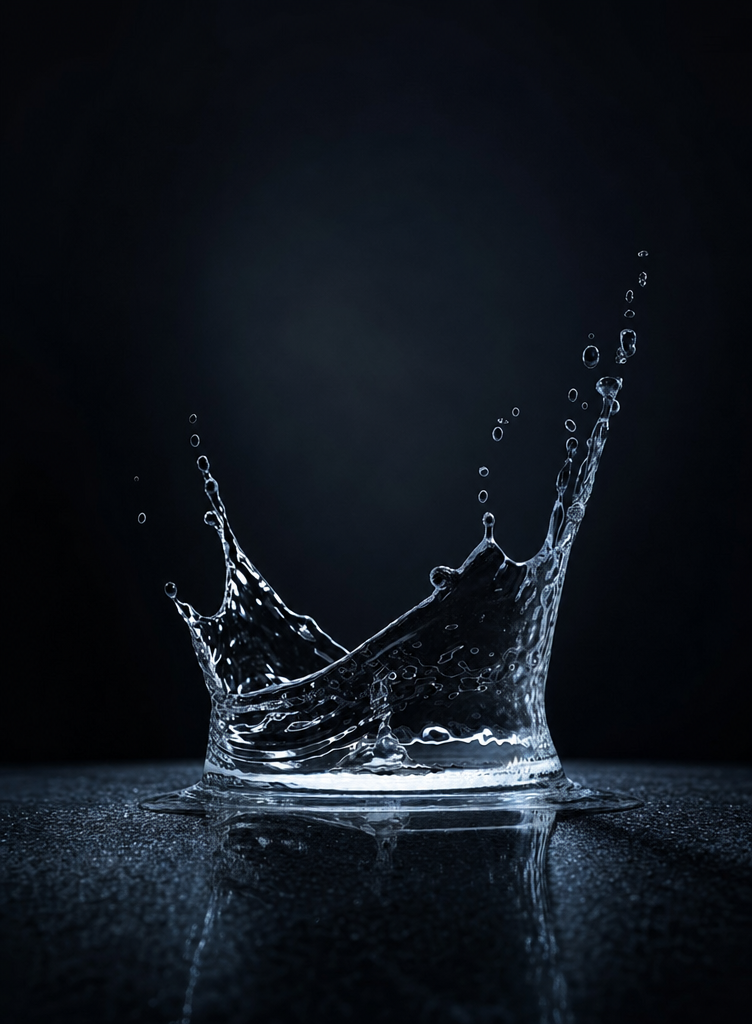
The centered crown-shaped splash gives the image its immediate focus, while “ultra-clean, minimal composition” prevents the sharply detailed arcs from becoming visually cluttered. The mood comes from the combination of “cooler blue-tinted dramatic side lighting,” “deep charcoal gradient background (not pure black),” and “strong contrast,” which produces a restrained gray image with cool highlights rather than a flat black backdrop. “High-speed studio photograph” and “sharp freezing of liquid droplets” are load-bearing for the suspended, crisp liquid texture, while the “slightly textured, low-gloss reflective surface” adds depth without competing with the crown.
FAQ
→How do I make the splash feel more energetic and explosive?
Replace “ultra-clean, minimal composition” with “dynamic off-center composition with radiating spray,” and change “water splash forming a crown shape” to “water impact exploding upward into a jagged crown with scattered droplets.” Keep “high-speed studio photograph” and “sharp freezing of liquid droplets” so the increased motion remains sharply resolved.
→How do I make the crown splash more visually prominent?
Change “centered” to “tight close-up framing with the crown filling most of the image,” and replace “subtle reflections” with “a controlled bright reflection directly beneath the crown.” You can also replace “deep charcoal gradient background” with “smooth darker charcoal background with generous separation around the splash” to preserve contrast around the enlarged subject.
→How do I create a warmer variation of this studio image?
Replace “cooler blue-tinted dramatic side lighting” with “warm amber side lighting with crisp golden highlights,” and change the dominant palette from gray to “charcoal, bronze, and warm white.” Keep “deep charcoal gradient background (not pure black)” and “low-gloss reflective surface” so the warmer light still retains the original restrained studio structure.
Learn the technique behind this
- Why can't AI spell, and how do I get readable text in an image? — Older diffusion models had no character-level representation of text, so they produced letterform-shaped texture instead of words.
- How should a prompt be structured, and does word order matter? — A prompt that behaves predictably names one subject first, then what it is doing, then where, then the light, then the lens or medium, then the style.
- Which aspect ratio should I use, and how does it change the image? — Aspect ratio determines what the model composes, not how it's cropped afterwards.
Related prompts
Playful brunette beauty ad portrait
Red Lip Balm with Lychee Freshness
Premium wellness pouch with golden spices
Teal-Accented Bunny Toy Studio Portrait