Why this works
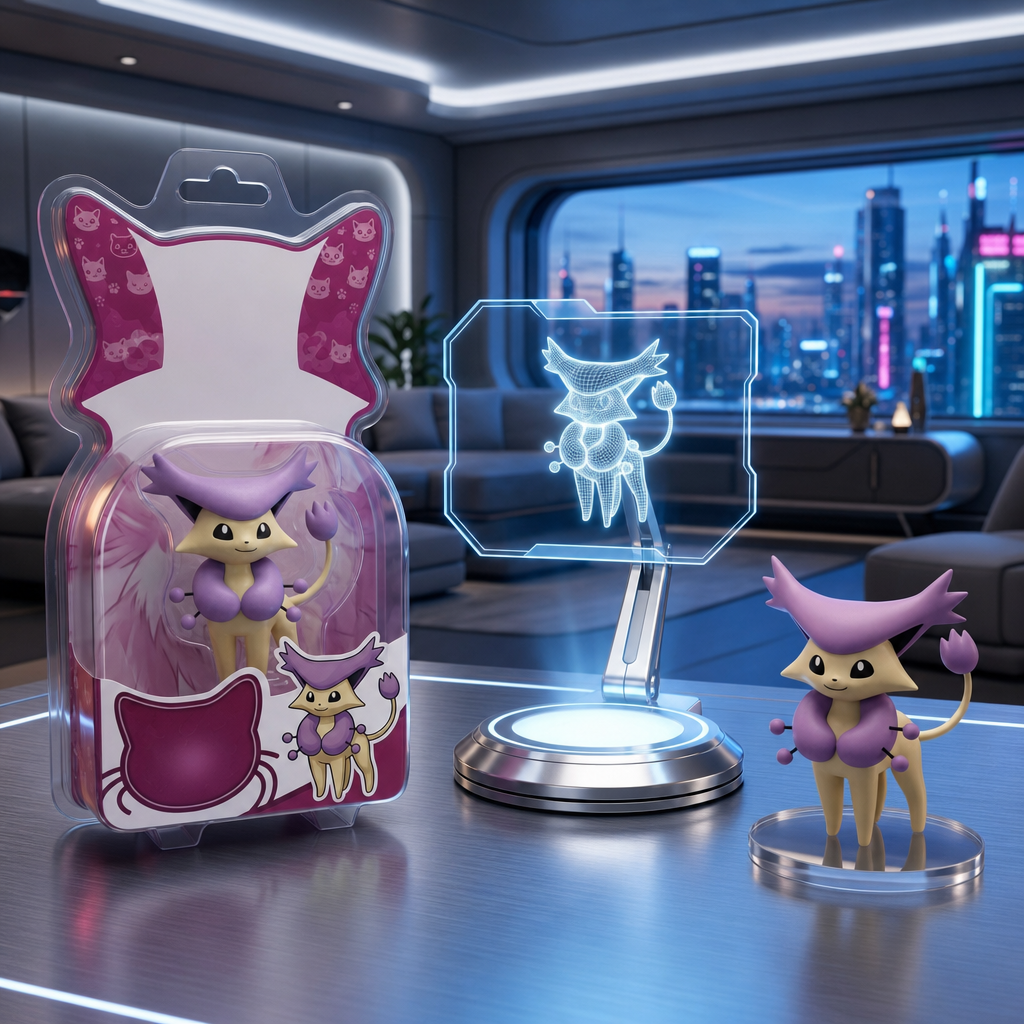
“Clean symmetrical composition” and “centered” keep the packaged figurine, holographic spec panel, and standalone figure reading as a controlled retail display rather than a casual scene. The polished futuristic mood comes from “modern luxury interior,” “cool ambient lighting,” and “subtle neon rim highlights,” while the purple, blue, and pink accents reinforce that palette against the black and brushed aluminum surfaces. “Shallow depth of field” and “ultra-sharp product focus” make the products visually dominant, with the “softened city skyline at blue hour” supplying scale and context without competing for attention.
FAQ
→How do I change this prompt for a warmer, more nostalgic retail mood?
Replace “cool ambient lighting” and “subtle neon rim highlights” with “warm tungsten display lighting, soft amber practical lights, and gentle golden reflections.” Change “blue hour” to “late-evening sunset,” and shift the dominant colors from “purple, blue, pink, black” toward “amber, cream, coral, and walnut brown.”
→How do I make the standalone figure the main focal point instead of the packaged product?
Replace “clean symmetrical composition” with “asymmetrical composition with the standalone figure in the foreground,” and change “ultra-sharp product focus” to “ultra-sharp focus on the small standalone figure, with the packaging slightly softened behind it.” Add “three-quarter close-up of the figure” and reduce the spec panel to “a partially cropped holographic panel at the edge of frame.”
→How do I turn this into a consistent series of collectible product mockups?
Keep the fixed phrases “clean symmetrical composition,” “premium retail packaging,” “transparent holographic spec panel,” and “brushed aluminum tabletop” across every prompt. Replace the subject description “cute collectible figurine” with a variable slot such as “cute [animal or character] collectible figurine,” and vary only the setting phrase, such as “cyberpunk boutique,” “minimalist museum display,” or “luxury spaceship showroom,” while retaining “cool ambient lighting” and “subtle neon rim highlights” for visual continuity.
Learn the technique behind this
- Why can't AI spell, and how do I get readable text in an image? — Older diffusion models had no character-level representation of text, so they produced letterform-shaped texture instead of words.
- Do negative prompts work, and what should go in one? — Negative prompts work on models that support a separate negative conditioning channel — mainly Stable Diffusion and FLUX-family models.
- How should a prompt be structured, and does word order matter? — A prompt that behaves predictably names one subject first, then what it is doing, then where, then the light, then the lens or medium, then the style.
Related prompts
Playful brunette beauty ad portrait
Red Lip Balm with Lychee Freshness
Premium wellness pouch with golden spices
Teal-Accented Bunny Toy Studio Portrait