Why this works
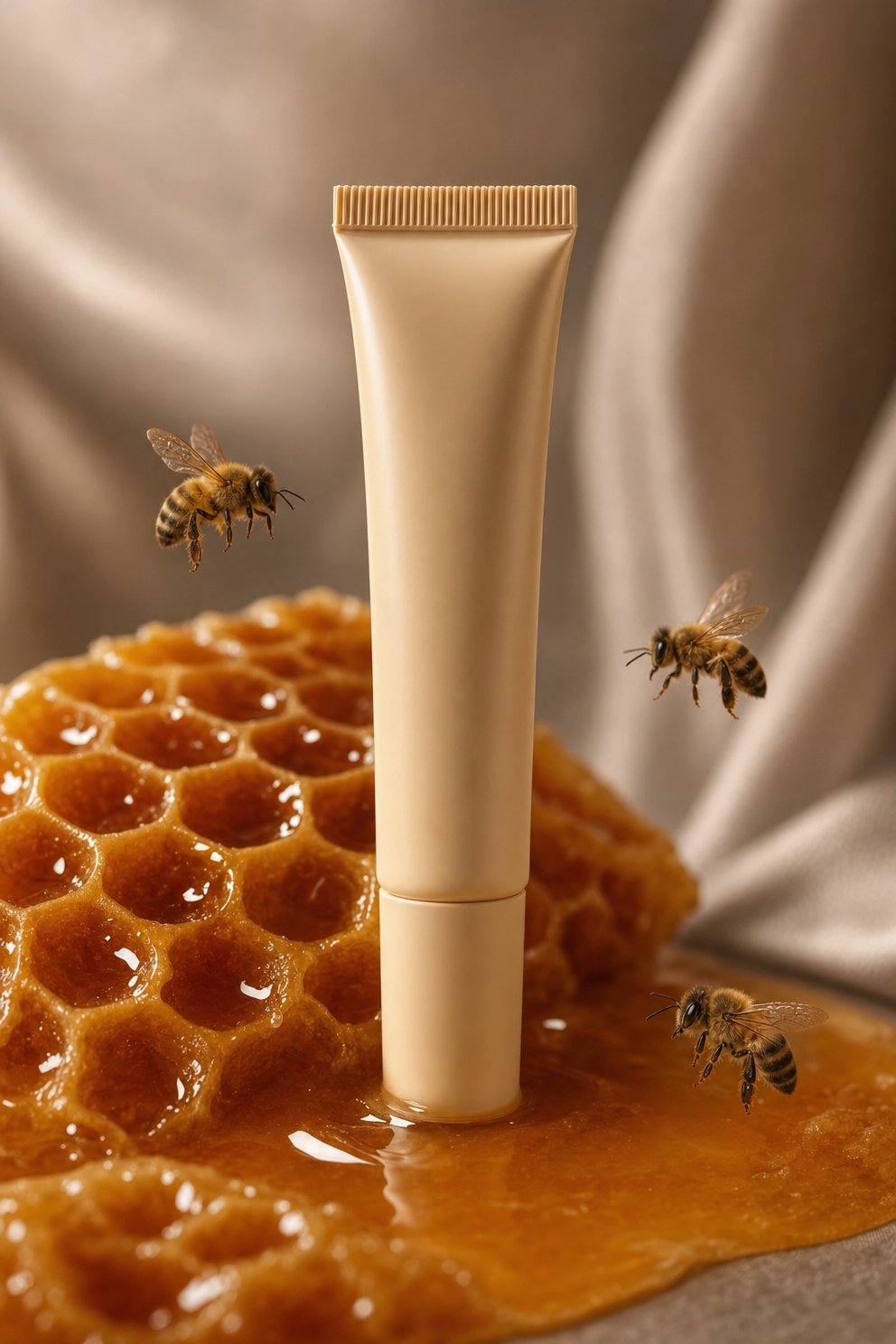
The centered, upright beige tube and “clean studio composition” give the product immediate hierarchy, while “close framing” keeps the bees and glossy honeycomb as supporting context rather than competing subjects. “Deeper amber-and-umber color scheme,” “muted satin taupe,” and “warm amber tones” create a controlled amber-brown harmony, with “soft side lighting” and “subtle rim highlights around the tube” separating the beige packaging from the darker backdrop. “Shallow depth of field” and “cinematic bokeh” push the hovering bees and rear fabric softly out of focus, while “crisp reflections and ultra-detailed textures” preserve the tactile gloss of the honeycomb and tube.
FAQ
→How do I make the bees more prominent without losing the tube as the main product?
Replace “a few realistic bees hovering nearby” with “three realistic bees in the foreground, one bee sharply focused beside the tube cap,” and change “shallow depth of field” to “moderate depth of field with the tube and nearest bee in focus.” Keep “centered” for the tube, but add “one bee overlapping the lower-right edge of the tube” to create a stronger secondary focal point.
→How do I shift this from warm luxury to a cooler, clinical skincare mood?
Replace “deeper amber-and-umber color scheme” and “warm amber tones” with “cool slate, ivory, and desaturated blue-gray palette,” and replace “muted satin taupe” with “matte pale gray backdrop.” Change “warm luxurious inviting mood” to “clean clinical dermatology aesthetic,” while keeping “soft side lighting” and “subtle rim highlights” for controlled product separation.
→How do I build a matching series with a different cosmetic product and setting?
Keep the structural phrases “Ultra-realistic high-end editorial product photography,” “centered,” “close framing,” “soft side lighting,” “subtle rim highlights,” and “cinematic bokeh.” Replace “beige cosmetic tube” with a specific package such as “frosted glass serum bottle,” replace “glossy honeycomb” with “polished travertine slab,” and change “realistic bees” to a setting-specific accent such as “scattered rosemary sprigs,” while retaining “crisp reflections and ultra-detailed textures” for visual continuity.
Learn the technique behind this
- Why can't AI spell, and how do I get readable text in an image? — Older diffusion models had no character-level representation of text, so they produced letterform-shaped texture instead of words.
- How do I keep one consistent style across a whole set of images? — Style consistency is more achievable than character consistency because style lives in describable attributes.
- How should a prompt be structured, and does word order matter? — A prompt that behaves predictably names one subject first, then what it is doing, then where, then the light, then the lens or medium, then the style.
Related prompts
Playful brunette beauty ad portrait
Red Lip Balm with Lychee Freshness
Premium wellness pouch with golden spices
Teal-Accented Bunny Toy Studio Portrait